New drivers face some of the highest auto insurance premiums on the road. Insurance companies view inexperience as a major risk factor, which means your rates will likely be significantly higher than seasoned drivers pay.

The good news? Low cost auto insurance for new drivers is absolutely achievable with the right strategy. We at Insurance Brokers of Arizona® have helped countless young drivers cut their premiums by hundreds of dollars annually through smart choices and comparison shopping.

Why New Drivers Pay So Much for Auto Insurance

Insurance companies charge new drivers substantially more because inexperience correlates directly with accident risk. According to the Insurance Institute for Highway Safety and Highway Loss Data Institute, teen drivers are about three times more likely to be involved in a fatal crash than drivers aged 20 and over. This data comes from decades of claims history, not speculation. When you have zero or minimal driving history, insurers lack a track record to assess your actual risk level, so they apply higher premiums across the board. The national average cost to add a 16-year-old to a parent’s policy sits around $6,874 per year, though this varies significantly by carrier and location.

How Carriers Price Teen Drivers Differently

Some companies like Auto-Owners charge roughly $3,266 annually to add a teen, while others exceed $5,500. This 60 percent spread reveals that your choice of carrier matters as much as your driving habits. Auto-Owners and Erie are roughly 50 percent cheaper than the national average for adding a teen, making them strong options for cost-conscious families. Age plays a major role too: a 16-year-old typically costs more than a 20-year-old on the same policy because crash risk remains elevated through the late teens.

The Timeline for Rate Decreases

Your age and years holding a license directly impact your premium. A newly licensed adult in their twenties faces rates nearly as high as a teenager because insurers treat anyone without established driving history as a higher risk. Rates drop consistently as you age and maintain a clean record-most insurers see significant decreases by age 25, though some companies like Progressive offer drops as early as 19 for safe drivers. A lapse in coverage or insurance history can raise your rates by about 17 percent on average, so maintaining continuous coverage matters more than you might think.

Single-percentage chart illustrating the average rate increase after an insurance coverage lapse for new drivers. - low cost auto insurance for new drivers

Vehicle Choice and Premium Impact

The vehicle itself amplifies costs for new drivers. A high-performance car like a Dodge Challenger can push monthly premiums toward $1,200 or higher for a teen, while a used sedan keeps costs manageable. Shopping around reveals massive differences in pricing philosophy across the industry. Your next step involves understanding which discounts and coverage adjustments can offset these high baseline rates.

Hub-and-spoke diagram showing key factors that influence new driver auto insurance premiums in the United States. - low cost auto insurance for new drivers

How to Cut Your Premiums as a New Driver

Compare Quotes Across Multiple Carriers

Comparing quotes from multiple insurers is non-negotiable if you want low costs. Auto-Owners, Erie, Geico, and State Farm price teen drivers differently based on their underwriting models, and the gaps are substantial. Adding a 16-year-old to Auto-Owners costs around $3,266 annually, while the same coverage at Geico runs about $5,507-a difference of $2,241 per year. You need to request quotes with identical coverage limits and deductibles to see apples-to-apples pricing instead of guessing which company offers the best deal. Most insurers offer free online quotes that take under five minutes, so you have no reason to settle with the first rate you receive.

Compact checklist of steps to get apples-to-apples auto insurance quotes for new drivers.

When you request quotes, specify the exact same liability limits, collision deductible, and comprehensive deductible across all companies so the numbers actually mean something.

Stack Discounts to Reduce Your Base Rate

Discounts stack on top of your base rate, and new drivers qualify for several that others don’t. Good Student Discounts reward full-time students maintaining at least a B average and can cut premiums by around 15 percent according to industry data, though amounts vary by insurer and state. Completing a defensive driving course through an approved program often yields another 5 to 10 percent savings. Some insurers like State Farm offer Steer Clear, which combines driver training certification with ongoing discounts, while Auto-Owners provides teen monitoring through a mobile app that tracks driving habits. You should ask your insurer about all available discounts since eligibility can change by state or carrier.

Adjust Deductibles and Choose the Right Vehicle

Increasing your collision and comprehensive deductible from $250 to $1,000 typically saves roughly $440 per year on average, a direct reduction that requires no behavioral changes. The vehicle you drive matters far more than most new drivers realize: a used sedan costs significantly less to insure than a sports car or high-performance model because repair costs and theft risk are lower. You should obtain a quote before purchasing a vehicle to prevent the shock of discovering your dream car is unaffordable to insure. This step alone can save you thousands of dollars over the life of your ownership and helps you make an informed decision about which vehicle fits your budget.

How to Keep Your Rates Low as You Drive

Build a Clean Driving Record

A clean driving record is your most powerful rate-reduction tool over time. Traffic violations, accidents, and insurance claims all trigger rate increases that can persist for three to five years on your record. A single at-fault accident can raise your premiums by 25 to 40 percent depending on your insurer, while a speeding ticket typically adds 10 to 15 percent. The inverse is equally true: maintaining zero violations for three consecutive years often qualifies you for accident forgiveness programs or safe driver discounts that offset your new-driver penalty. Some insurers apply these discounts automatically once you hit the milestone, while others require you to request them. Every month without an incident moves you closer to substantially lower rates. Most insurers see measurable decreases by age 25, but your actual rate drop depends more on your driving history than your age alone. A 25-year-old with two accidents pays more than a 22-year-old with a spotless record, so your actions behind the wheel matter immediately.

Bundle Your Policies for Maximum Savings

Bundling home and auto insurance with the same carrier typically saves over $950 annually according to industry data, a discount that compounds your new-driver savings. Many insurers offer additional bundling discounts when you add renters, RV, or boat policies to the mix. Bundling simplifies policy management and gives you leverage to negotiate better rates during annual reviews. When your renewal notice arrives, contact your insurer and mention that you are considering switching to a competitor for bundled coverage. This statement alone often triggers a retention discount that reduces your quoted renewal rate by 5 to 15 percent.

Shop Annually and Switch When Necessary

Your rates should decrease as you age and gain experience, so shop competing quotes annually during your renewal window. If another carrier offers significantly lower pricing, switch without hesitation. Loyalty discounts rarely compensate for rate increases that accumulate when you stay put. Insurance Brokers of Arizona® can help you evaluate multiple carriers and bundling options simultaneously, ensuring you capture every available discount without the hassle of managing separate quote requests.

Final Thoughts

Finding low cost auto insurance for new drivers requires action, not hope. Start with quotes from at least three carriers using identical coverage limits and deductibles-the $2,000+ annual differences between Auto-Owners and Geico prove your choice of insurer directly impacts your wallet. Stack every discount you qualify for, increase your deductible to $1,000 if feasible (saving roughly $440 annually on average), and select a vehicle you can actually afford to insure before you purchase it.

Build your clean driving record from day one, since every month without a violation moves you closer to substantially lower rates. Bundle your auto policy with home or renters insurance to capture savings exceeding $950 per year, then shop annually during your renewal window to prevent overpaying for coverage. Most insurers apply significant discounts to drivers with spotless histories once they reach age 25, but your actual rate drop depends more on your driving history than your age alone.

We at Insurance Brokers of Arizona® work with over 40 reputable carriers, which means we compare pricing and discounts across the entire market without you spending hours on individual quote requests. Contact Insurance Brokers of Arizona® today to start your search for affordable coverage and let our team handle the comparison shopping so you get accurate, competitive quotes in minutes.

Disclaimer: The information provided in this blog is for general informational purposes only and does not constitute legal, financial, or insurance advice. Coverage options, terms, and availability may vary. Please consult with a licensed professional for advice specific to your situation.
Turning 65 shouldn’t mean paying through the nose for auto insurance. Yet many seniors face premiums that jump significantly once they hit a certain age, even if they’re safer drivers than they were decades ago.

At Insurance Brokers of Arizona®, we’ve helped hundreds of older drivers find policies that actually fit their budgets and driving patterns. This guide walks you through why rates climb, what discounts you qualify for, and how to lock in real savings.

Why Elderly Drivers Cost More to Insure

Insurance companies don’t raise rates on senior drivers out of spite. The numbers tell a story that insurers take seriously. According to Bankrate data from Quadrant Information Services, a 70-year-old male driver pays around $2,663 annually for full-coverage auto insurance, compared to roughly $2,455 for a 60-year-old. That’s a noticeable jump.

Infographic showing key risk factors that raise auto insurance costs for seniors - auto insurance for the elderly

The Insurance Institute for Highway Safety reports that while seniors are involved in fewer fatal crashes per capita, they do experience higher injury severity when accidents occur. This matters because insurers price risk based on the cost of claims, not just accident frequency. A 70-year-old involved in a collision faces longer recovery times and potentially higher medical expenses, which translates directly into higher premiums. Consumer Reports surveyed over 40,000 policyholders and found that more seniors reported rate increases in the past 12 months than younger drivers, underscoring how age factors into pricing decisions.

Physical changes that come with aging-slower reaction times, reduced vision, and decreased mobility-affect how insurers assess your driving profile. These aren’t character judgments; they’re actuarial reality. The data shows that drivers over 80 face the steepest increases, with premiums climbing more sharply than in any other age bracket.

The Real Reason Rates Jump at Certain Ages

Insurers don’t apply a blanket senior surcharge. Instead, they track specific risk factors that correlate with age. Medical claims from accidents involving older drivers tend to be costlier because recovery is slower and complications are more common. Additionally, vision changes and medication side effects that accompany aging can influence claim patterns. In six states-California, Hawaii, Massachusetts, Michigan, North Carolina, and Pennsylvania-insurers cannot use age as a direct rating factor, yet premiums still vary based on accident history and other measurable factors. This shows that age itself isn’t the whole story; it’s the underlying risks age brings.

A clean driving record remains your strongest defense against rate increases, regardless of your age. Bankrate’s analysis shows that maintaining a spotless record for five years can qualify you for meaningful discounts that offset age-related increases. The Hartford reports that seniors aged 70 and older average $1,450 annually for car insurance, which suggests that proper discounts and policy choices can keep costs reasonable even as you age.

What Senior Drivers Get Wrong About Their Rates

The biggest misconception is that you’re helpless against age-based pricing. Many seniors accept rate increases without shopping around, assuming all insurers charge roughly the same. This is false. Consumer Reports found that drivers who switched insurers in the past year saved a median of $461, with 28 percent saving between $250 and $499 and another 28 percent saving $500 to $999. Some saved $1,000 or more.

Two-bar chart showing percentages of seniors who saved by switching insurers

Your age is just one variable in a complex pricing formula. Your ZIP code, vehicle type, driving history, bundling options, and selected discounts matter enormously. A senior with a clean record and multiple policies bundled together will pay far less than a younger driver with accidents on their record.

Shopping annually isn’t optional if you want fair pricing. The Hartford’s data shows that premiums for seniors aged 50 to 59 average $1,942 annually, dropping to $1,517 for those 60 to 69, then to $1,450 for those 70 and older. This pattern reveals that aggressive discounting and policy adjustments can actually lower your costs as you age, contradicting the assumption that getting older always means paying more. The real issue is inaction, not age.

How Insurers Assess Your Individual Risk

Insurers evaluate each driver’s profile through multiple lenses beyond age alone. Your medical history, current medications, and vision test results (required during license renewal in many states) all influence how carriers price your policy. Some insurers use telematics programs that monitor your actual driving behavior, which can work in your favor if you drive safely. These programs reward cautious habits with discounts that offset age-related increases. Your vehicle choice also matters significantly. Newer cars equipped with automatic emergency braking, blind spot warnings, and rear cross-traffic alerts reduce claim costs, and insurers recognize this through lower premiums. The combination of a safe vehicle, clean driving record, and active participation in discount programs can substantially reduce what you pay, regardless of your age.

Understanding these assessment methods helps you take control of your rate. The next section explores the specific discounts and strategies that senior drivers can use to lower their premiums and find coverage that truly fits their needs.

How to Cut Your Auto Insurance Costs as a Senior

Discounts That Actually Reduce Your Premiums

Discounts exist for senior drivers, but most fail to pursue them actively. That’s money left on the table. GEICO offers seniors over 50 a defensive driving discount for completing an approved course, which reduces premiums by 5 to 15 percent. The Hartford provides a similar benefit, allowing seniors to earn discounts for up to three years after finishing a defensive driving course. AARP members access exclusive programs through The Hartford, with average savings around $597 when switching from other carriers. These aren’t small numbers. If you pay $1,500 annually for full coverage, a 15 percent discount saves you $225 per year. The key is actually applying for them. Most insurers won’t volunteer these discounts; you must ask.

A five-year clean driving record qualifies you for loyalty discounts at most carriers, and some offer retirement discounts specifically for fully retired drivers. Low-mileage discounts apply if you drive fewer than 5,000 to 7,500 miles annually, which describes many retirees. Usage-based programs like GEICO’s DriveEasy track your actual driving behavior and reward safe habits with discounts up to 15 percent within 60 days, plus potential renewal discounts reaching 40 percent. These programs work because they measure what actually matters: how you drive, not your age.

Shopping Around Reveals Hidden Savings

Shopping around annually is non-negotiable if you want fair pricing. Consumer Reports data shows the median savings when switching insurers is $461, but that’s just the average. Nearly 30 percent of switchers saved between $500 and $999, and 13 percent saved over $1,000. Getting three to five quotes from different carriers takes less than an hour online and reveals price differences of 30 to 50 percent for identical coverage. The Hartford’s data confirms this variation, showing seniors aged 70 and older average $1,450 annually, but that figure masks significant variation by carrier and location.

Vehicle Choice and Coverage Adjustments

Your vehicle choice influences premiums substantially. Newer cars with automatic emergency braking, blind spot warnings, and rear cross-traffic alerts cost less to insure because insurers pay fewer claims on vehicles equipped with these features. If you drive an older vehicle worth only a few thousand dollars, dropping collision or comprehensive coverage often makes financial sense. Raising your deductible from $500 to $1,000 typically saves 10 to 20 percent on collision premiums.

Bundling and Combined Strategies

Bundling auto with homeowners or renters insurance yields 10 to 25 percent discounts across policies. The combination of a safe vehicle, clean driving history, multiple discounts, and bundled policies creates substantial savings that offset any age-related increases. These strategies work together to lower what you pay, but selecting the right coverage for your specific situation requires careful evaluation of your actual needs and driving patterns.

Checklist of actionable ways seniors can reduce auto insurance costs - auto insurance for the elderly

Specialized Auto Insurance Options for Seniors

Most seniors don’t drive like they did at 40. Fewer miles, shorter trips, daytime driving only-these patterns define retirement for many. Yet standard auto insurance policies ignore this reality and charge you as though you commute 40 miles daily. This mismatch between your actual driving and your premium is where real savings hide.

Low-Mileage and Usage-Based Programs

Low-mileage and usage-based insurance programs align what you pay with how you actually drive. If you drive under 5,000 to 7,500 miles annually, a low-mileage policy reduces your premium by 10 to 25 percent compared to standard coverage. GEICO’s DriveEasy program tracks your driving behavior through your smartphone or a plug-in device and rewards safe habits with discounts up to 15 percent within 60 days, plus potential renewal discounts reaching 40 percent. The Hartford’s TrueLane program offers similar flexibility, rewarding cautious driving patterns that most seniors naturally exhibit.

Pay-per-mile programs like OCHO take this further, charging a base rate plus mileage fees with no down payment required, making them ideal for retirees who drive sporadically. The math works strongly in your favor. If you drive 3,000 miles annually instead of the national average of 12,000 to 15,000 miles, your risk profile drops significantly. Insurers recognize this through lower premiums, but only if you select a program designed to capture it. Standard policies penalize you for being low-mileage because they’re structured for average drivers.

Coverage Tailored to Your Vehicle and Situation

Coverage options for seniors require different thinking than coverage for younger drivers. If you own a vehicle worth only $3,000 to $5,000, carrying collision and comprehensive coverage costs more than the potential payout, making it financially illogical. Dropping collision coverage on older vehicles while maintaining full liability protection is standard practice for many seniors.

Raising your deductible from $500 to $1,000 saves 10 to 20 percent on collision premiums without meaningfully increasing your out-of-pocket risk, especially if you drive cautiously. However, never sacrifice liability limits to save money. Your state’s minimum requirements exist because liability claims from accidents can exceed $100,000 in medical costs alone. This protection matters more than any premium reduction.

Finding the Right Coverage for Your Needs

Your specific vehicle values, driving patterns, and financial situations determine what coverage actually protects you without wasting money on unnecessary protection. This requires understanding your actual cash value for each vehicle, your annual mileage, your driving habits, and your ability to cover a higher deductible if needed.

A 75-year-old driving 4,000 miles yearly in a 2015 Honda Civic worth $8,000 needs fundamentally different coverage than someone driving 15,000 miles annually in a newer vehicle. Getting this right requires evaluating your situation against available options from multiple carriers, then selecting programs and coverage levels that fit your specific circumstances rather than accepting default options designed for average drivers. Insurance Brokers of Arizona® works with seniors to evaluate these factors and design coverage that protects them without wasting money on unnecessary protection.

Final Thoughts

Senior auto insurance doesn’t have to drain your retirement budget. The path forward is straightforward: stop accepting rate increases without question, actively pursue available discounts, and align your coverage with how you actually drive. A 70-year-old paying $2,663 annually for full coverage can reduce that significantly through defensive driving courses, bundling policies, and switching to carriers that reward safe driving habits. The Hartford’s data shows seniors aged 70 and older average $1,450 annually, proving that aggressive cost management works.

Pull your last renewal notice and note your annual premium, coverage limits, and deductibles. Then obtain quotes from at least three carriers using identical coverage levels-you’ll likely discover significant price differences for the same protection. Check whether you qualify for senior discounts, defensive driving course reductions, low-mileage programs, or bundling savings. If you drive fewer than 7,500 miles annually, usage-based programs like GEICO’s DriveEasy or The Hartford’s TrueLane could save you 15 to 40 percent.

This process takes time, and many seniors skip it because shopping for auto insurance for the elderly feels overwhelming. We at Insurance Brokers of Arizona® partner with multiple carriers to find coverage that fits your specific situation, not generic templates. Contact us to review your current coverage and discover what you’re likely overpaying.

Disclaimer: The information provided in this blog is for general informational purposes only and does not constitute legal, financial, or insurance advice. Coverage options, terms, and availability may vary. Please consult with a licensed professional for advice specific to your situation.
Fire can destroy a home in minutes, yet most homeowners don’t fully understand their home fire insurance coverage. At Insurance Brokers of Arizona®, we’ve seen firsthand how gaps in coverage leave families vulnerable when they need protection most.

This guide walks you through what standard policies cover, where the holes are, and how to build a protection plan that actually works for your situation.

What Does Home Fire Insurance Actually Cover

Standard Coverage and Common Exclusions

Standard homeowners insurance covers fire damage to your home’s structure, other structures on the property like detached garages, and personal belongings inside, according to the National Association of REALTORS. Most policies cover accidental fires from electrical malfunctions, lightning, candles, and grease fires, but they exclude damage from negligence, arson, or poor maintenance. This distinction creates real problems for homeowners who assume they’re protected when they’re not. If you caused a fire through reckless behavior or ignored obvious hazards, your insurer will reject the claim outright. Additionally, standard policies typically don’t cover fires caused by nuclear hazards or government action, though these exclusions rarely matter in practice. The critical step is reading your actual policy document, not just the summary your broker provides, because coverage gaps hide in the details of what your specific insurer considers a covered peril versus an excluded one.

Replacement Cost Versus Actual Cash Value

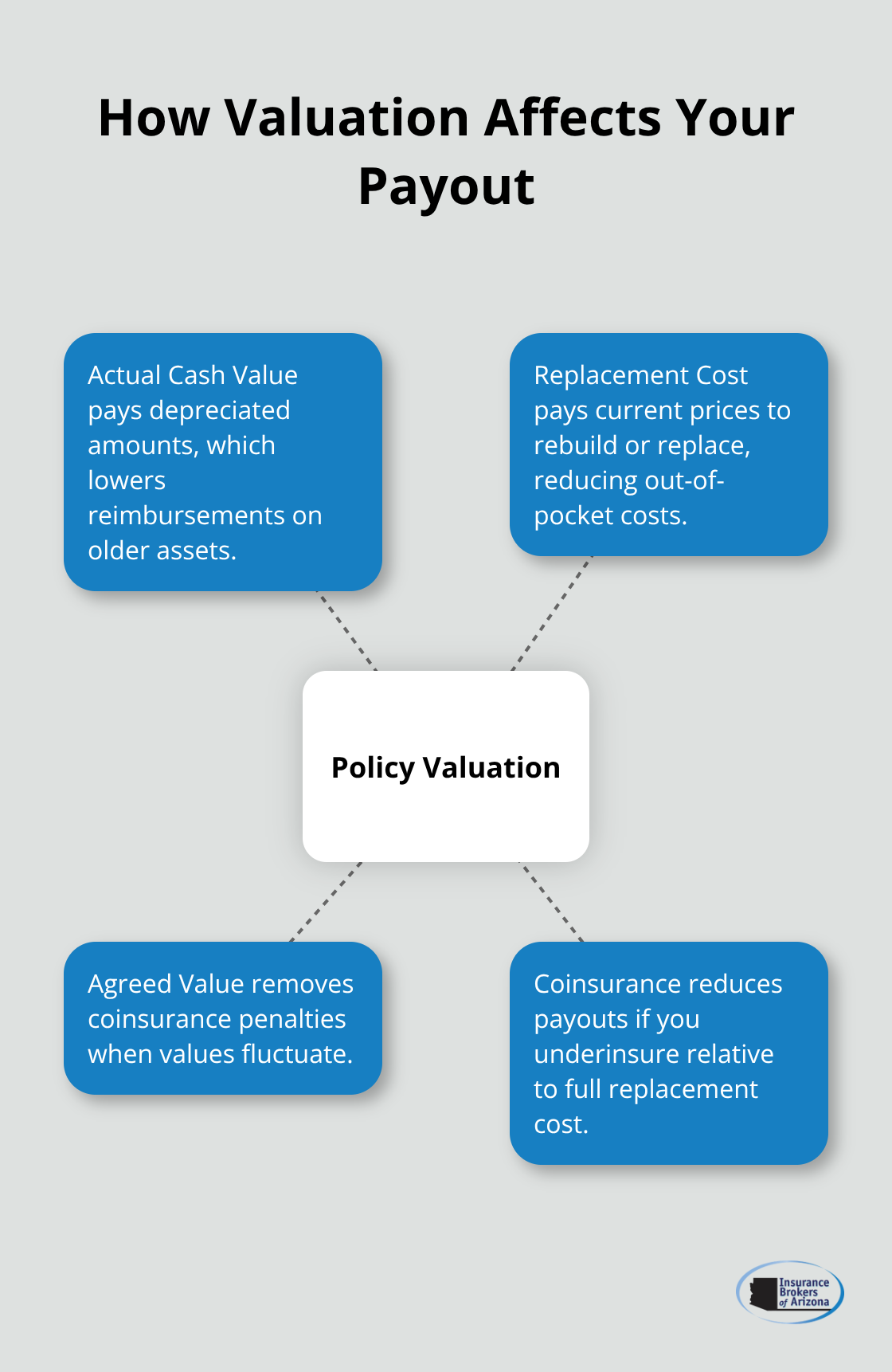
Your payout method determines whether you rebuild or suffer a financial loss on top of losing your home. Actual Cash Value pays the depreciated amount of what you lost, so a ten-year-old roof might be worth only 30 percent of its replacement cost. Replacement Cost coverage pays what you actually need to rebuild or replace items at current prices, which is dramatically different. If your home costs $400,000 to rebuild today but your Actual Cash Value policy only pays $280,000 after depreciation, you’re out $120,000 before you even start repairs.

Infographic showing that a ten-year-old roof may be valued at only 30% under Actual Cash Value. - home fire insurance coverage

Most homeowners should demand Replacement Cost coverage because the extra premium is minimal compared to the protection gap. Some policies offer extended Replacement Cost or inflation protection riders that automatically adjust your coverage limit as construction costs rise, which matters significantly in Arizona’s growing real estate market. Smoke damage and water damage from firefighting efforts also fall under standard coverage but sometimes only for a limited period (occasionally up to one year according to some policies). The distinction between these two approaches isn’t theoretical-it determines whether you can actually rebuild your life or live with permanent loss.

What Fire Damage Claims Actually Include

Fire damage claims involve more than just burn marks on walls. Standard policies cover damage to the home structure itself, but also smoke damage, soot damage, and water damage from firefighting efforts or burst pipes caused by heat. Loss of Use coverage, sometimes called Additional Living Expenses, pays for temporary housing, meals, and other costs while your home is uninhabitable-but you must keep receipts and document every expense to get reimbursed. Debris removal and demolition costs are typically covered, though limits apply. Landscaping damage including destroyed trees and plants usually has a per-tree limit around $500, though mature trees can be valued up to $5,000 each according to standard policy language. Contents coverage reimburses destroyed furniture, electronics, clothing, and other belongings, but sub-limits often apply to jewelry, cash, and collectibles, meaning you might only recover a fraction of their value.

Documentation That Protects Your Claim

You should document everything with photos and video before any fire occurs, keeping receipts in a secure location or backed up electronically. When fire destroys your home, you’ll need this evidence to prove what you owned and substantiate your claim for full reimbursement. The specifics of what you lost matter enormously when adjusters evaluate your claim, and vague descriptions lead to lower payouts. Start now by photographing your belongings, recording serial numbers, and storing this information safely. This preparation transforms a chaotic claims process into one where you control the narrative about what you actually owned and what it cost to replace.

Understanding Coverage Limits and Hidden Gaps

Your policy contains specific limits on different types of coverage, and these limits create real gaps that leave you underprotected. Valuable items like jewelry, art, or collectibles often have sub-limits that pay only a fraction of their actual value unless you schedule them separately on your policy. Additional Living Expenses coverage has time limits (sometimes 12 months) that may not cover your entire displacement if rebuilding takes longer. These gaps become obvious only when you file a claim, which is far too late to add protection. The next section explores the major gaps that standard policies leave unaddressed and how these exclusions affect homeowners in Arizona’s specific fire environment.

Where Standard Fire Insurance Falls Short

Wildfire Exclusions in High-Risk Areas

In high wildfire risk areas across Arizona, private insurers often refuse coverage or exclude wildfire damage entirely from standard homeowners policies. According to the National Association of REALTORS, some insurers in these zones won’t underwrite new policies at all, forcing homeowners toward non-admitted surplus lines carriers that operate outside standard state regulations. These surplus lines policies cost significantly more and offer limited protections compared to standard market coverage.

Diagram showing coverage paths and actions for homeowners in Arizona wildfire zones. - home fire insurance coverage

If your home sits in a wildfire zone and you can’t find traditional coverage, you’ll likely end up in a FAIR plan (Fair Access to Insurance Requirements), which exists as a safety net in most states but charges higher premiums and provides less comprehensive protection than private policies.

The real trap occurs when homeowners assume their standard policy covers wildfire damage-it typically doesn’t. You must explicitly ask your insurer whether wildfire exclusions apply to your specific property and request coverage details in writing. If an insurer denies you coverage due to wildfire risk, contact your state insurance commissioner for information about alternative options and fire risk maps that influence underwriting decisions.

Negligence and Arson: Complete Coverage Rejection

Damage caused by negligence or arson creates a different problem: your insurer will reject the entire claim without exception. If you caused a fire through reckless behavior, ignored obvious fire hazards, or someone in your household committed arson, the policy simply won’t pay. This isn’t a technicality-it’s a fundamental boundary in insurance contracts that protects the system from paying for intentional or grossly negligent losses.

Additional Living Expenses: Time Limits That Catch You Off Guard

Additional Living Expenses coverage, which reimburses temporary housing and meals while your home is uninhabitable, sounds straightforward but contains critical limitations that catch homeowners off guard. Most policies cap this coverage at 12 months, yet rebuilding a home often takes longer, especially in Arizona’s competitive construction market. You must track every receipt for lodging, groceries, and related expenses because insurers require proof of actual costs incurred.

Start keeping these records immediately after a fire, photograph your temporary living situation, and submit claims promptly rather than waiting until the end of your displacement. If rebuilding extends beyond your policy’s time limit, you’ll cover the remaining costs yourself, making it essential to understand your specific time limits before disaster strikes. This gap between coverage limits and actual rebuilding timelines creates significant financial exposure that most homeowners don’t anticipate until they’re already displaced and facing months of uncovered expenses.

Building Your Fire Insurance Strategy

Calculate Your True Replacement Cost, Not Market Value

The gap between what you think you’re covered for and what you actually are covered for costs homeowners thousands of dollars every year. The solution starts with understanding your home’s true replacement cost, not its market value-these are completely different numbers. A home worth $500,000 on the market might cost $650,000 to rebuild due to labor, materials, and code compliance requirements in Arizona.

Your insurance agent should conduct a detailed replacement cost analysis of your specific property, accounting for square footage, construction type, finishes, and local building code upgrades required post-fire. Request this analysis in writing and update it every two to three years as construction costs rise. Arizona’s construction market has seen material costs increase roughly 5 to 8 percent annually over the past five years, meaning a policy adequate in 2023 may leave you underprotected by 2026.

Demand Professional Assessment Over Online Estimates

Don’t rely on online calculators or rough estimates. Demand a professional assessment that itemizes your dwelling coverage, other structures coverage, and personal property limits separately. Once you have accurate replacement cost figures, compare them directly against your current policy limits. If your limits fall short, you face a coverage gap that no discount will solve.

Add Endorsements That Protect Against Rising Costs

Arizona homeowners in wildfire zones absolutely need extended replacement cost endorsements and inflation protection riders that automatically increase your limits annually. These additions typically cost 5 to 10 percent more but prevent the catastrophic scenario where rebuilding costs exceed your policy limit mid-project. Additionally, scheduled personal property coverage for jewelry, art, firearms, or collectibles is non-negotiable if you own items worth more than standard sub-limits allow.

Standard policies cap jewelry coverage at $1,500 to $2,500 regardless of actual value, making separate scheduling essential for anyone with engagement rings, watches, or inherited pieces. Request quotes from multiple carriers with identical coverage specifications-not just dwelling limits but also deductibles, Additional Living Expenses periods, and any wildfire exclusions.

Checklist of key endorsements and comparison tips for Arizona home fire coverage.

Compare Quotes and Identify Carrier-Specific Discounts

Comparing three or more quotes reveals premium variations of 20 to 40 percent for identical protection, and some carriers offer discounts for home safety features like fire-resistant roofing, updated electrical systems, or proximity to fire hydrants. Ask each insurer specifically about their wildfire exclusion policies and whether they’ll cover your property given current risk assessments.

If traditional carriers decline you, non-admitted surplus lines carriers can provide coverage in high-risk areas, though these policies cost more and operate outside state guaranty fund protections. Shop annually because rates and underwriting appetite change constantly. A carrier that declined you last year might accept you today, or your current insurer might increase rates dramatically if fire risk assessments change. Keep detailed records by requesting quotes in writing and saving correspondence from each insurer.

Final Thoughts

Home fire insurance coverage protects your family’s financial security, but only if you understand what your policy actually covers and where gaps exist. Most homeowners discover their coverage limitations after a fire destroys their home, when it’s far too late to add protection. You now know that standard policies exclude wildfire damage in high-risk areas, reject claims from negligence or arson, and cap Additional Living Expenses at timeframes that rarely match actual rebuilding timelines.

Start by requesting a detailed replacement cost analysis from your current insurer and compare that figure against your actual policy limits. If your home costs $650,000 to rebuild but your policy limits are $500,000, you have a $150,000 gap that no discount will solve. Update this analysis every two to three years because Arizona’s construction costs rise consistently, making policies adequate today potentially insufficient by 2026.

Shop your coverage with at least three carriers, requesting identical specifications so you can compare apples to apples. Ask each insurer directly about wildfire exclusions, Additional Living Expenses time limits, and available discounts for fire-resistant features. At Insurance Brokers of Arizona®, we work with over 40 reputable carriers to find home fire insurance coverage that actually protects your specific situation rather than leaving you with gaps.

Disclaimer: The information provided in this blog is for general informational purposes only and does not constitute legal, financial, or insurance advice. Coverage options, terms, and availability may vary. Please consult with a licensed professional for advice specific to your situation.