Homeowners insurance rates vary wildly depending on where you live, how old your home is, and your personal history. Most homeowners overpay because they don’t understand what actually moves the needle on their premiums.

At Insurance Brokers of Arizona®, we’ve helped hundreds of homeowners cut their costs by making smart choices about coverage and discounts. This guide walks you through the exact factors that determine your rates and the strategies that work.

What Actually Moves Your Homeowners Insurance Premiums

Home Age and Construction Materials

Your home’s age is one of the most predictable cost drivers. A home built in 2025 costs roughly $1,425 per year to insure compared to a 1984-built home at about $2,490 per year under identical policy terms, according to NerdWallet data. Older homes carry higher premiums because aging electrical systems, plumbing, and roofing increase claim risk. Construction materials matter just as much. A brick home costs less to insure than wood frame because brick resists fire and weather damage better. If you’re buying or renovating, upgrading to impact-resistant roofing or modern electrical systems directly reduces what you’ll pay.

Fire Station Proximity and Infrastructure

The closer you live to a fire station, the lower your premium. Distance to water sources and fire suppression infrastructure, measured by ISO’s Fire Suppression Rating Schedule, determines your fire risk category. These factors aren’t negotiable, but they’re worth evaluating before you buy a property.

Location Creates Wild Price Swings

Oklahoma City homeowners pay roughly $9,770 per year while San Jose, California residents pay about $1,475 annually for comparable coverage. This sevenfold difference reflects regional disaster risk, building code standards, and labor costs. Coastal areas face hurricane and wind risk that trigger separate deductibles or coverage restrictions.

Hub-and-spoke showing location-based risk factors that raise U.S. homeowners insurance premiums

Tornado-prone regions see higher premiums. Wildfire risk in western states pushes costs up significantly. Before purchasing a home, use tools like First Street or Climate Check to assess flood, tornado, and wildfire exposure in your area. These hazards directly translate to premium increases.

Claims History and Credit Impact

Your claims history stays on your CLUE report for seven years and follows you to new properties. A single fire loss of $80,000 raised premiums by about $137, while a $31,000 liability claim increased rates by $141, per Bankrate data. Smaller claims also count-a $5,000 theft claim raised premiums by $150.

Checklist of claim and credit factors that raise or lower homeowners insurance costs - Homeowners insurance rates

This means filing minor claims costs more than just the deductible. Credit history matters significantly too. Improving from poor to average credit saves about $1,389 per year on average. In most states, marital status affects rates, with married homeowners paying less than single ones (Hawaii and Massachusetts prohibit using marital status as a rating factor).

These personal factors compound with home characteristics to determine your final rate, which is why understanding what insurers measure matters before you shop for coverage.

How to Cut Your Premiums Without Sacrificing Coverage

Bundle Policies to Unlock Immediate Savings

Bundling your homeowners and auto policies with the same insurer cuts what you pay faster than any other single move. Most carriers offer 10–25% discounts when you combine policies, though the actual savings depend on the insurer and your location. The catch is that bundling discounts don’t always stack the way you’d hope. Some insurers apply the discount to your homeowners policy only, while others reduce both. Before you commit to bundling, get quotes for both policies separately and together so you see the real number. If the bundle saves you $300 annually but costs you $400 more on auto, the math doesn’t work.

Raise Your Deductible to Lower Monthly Costs

Your deductible is the single most controllable lever on your premium. Raising your deductible from $1,000 to $2,500 typically cuts premiums by roughly 9%, according to NerdWallet analysis, which translates to savings around $225 per year on a $2,490 benchmark policy. Going higher to $5,000 can push savings to 15–20%, but only if you can actually afford to pay that amount out of pocket when a claim happens. The mistake homeowners make is choosing a deductible they cannot cover. If a hail storm damages your roof and you owe $5,000 before insurance kicks in, you need cash on hand to pay it.

Percentage reductions from common savings strategies for U.S. homeowners insurance - Homeowners insurance rates

Install Safety Features That Reduce Risk and Premiums

Home security and safety upgrades deliver measurable premium reductions without increasing your out-of-pocket risk. Monitored alarm systems, smoke detectors, and sprinkler systems can yield 15–20% savings on some policies. Storm shutters and impact-resistant roofing qualify you for additional discounts in coastal and tornado-prone areas. These improvements cost money upfront, but they lower your annual premium permanently and increase your home’s resilience to actual disasters. The investment pays for itself through premium reductions over time, and you gain the added benefit of stronger protection when severe weather strikes.

Your home’s specific characteristics and your personal choices determine whether you overpay or find real value. The next section covers the mistakes that trap homeowners into paying more than they should.

Common Mistakes Homeowners Make When Shopping for Insurance

Choosing Coverage Limits That Are Too Low

Underinsuring your home is the costliest mistake homeowners make, yet it happens constantly. Many people lower their dwelling coverage to reduce premiums without understanding the consequences. A home with a $300,000 rebuild cost insured for only $150,000 leaves a $150,000 gap that you’ll pay out of pocket after a major loss. Bankrate data shows dwelling coverage at $150,000 costs about $1,459 annually, while $300,000 coverage runs roughly $2,424. The $965 annual difference feels significant until you face a house fire.

Your dwelling limit should reflect your home’s rebuild cost, not its market value or purchase price. Rebuild cost includes materials and current labor rates in your area, which vary dramatically by region. Oklahoma homeowners might rebuild for less than California homeowners in the same square footage. Before you set your coverage limit, get a rebuild cost estimate from a contractor or use your insurer’s cost calculator.

Many policies also tie liability and personal property coverage to your dwelling limit as a percentage, so cutting dwelling coverage reduces protection across your entire policy. This compounds the problem because you’re not just underinsuring the structure-you’re also cutting liability protection when a visitor gets injured on your property.

Ignoring Premium Increases at Renewal

Your insurer will raise rates whether your home changes or not, so treating renewal as automatic is expensive. The average homeowner saw premium increases over the past year according to Harris Poll data, driven largely by climate disasters and inflation in labor costs. Set a calendar reminder 30 days before your renewal date and get fresh quotes from at least three carriers with identical coverage limits and deductibles.

This comparison reveals whether you’re paying more than the market rate or whether your insurer has simply raised prices across the board. Some insurers offer loyalty discounts of 5–10% after several years, but these disappear if you don’t actively shop. The Zebra and other quote aggregators let you compare rates from 100+ insurers in minutes, making it practical to check your options annually.

Taking Action on Rate Comparisons

Getting three quotes takes less than 15 minutes and often saves $500 to $1,500 per year. Homeowners who shop for insurance every two years instead of every five years pay roughly 20% less over time because they catch rate increases early and switch before the damage compounds. Each quote you obtain provides leverage to negotiate with your current insurer or justification to move your policy to a carrier that values your business more fairly.

Final Thoughts

Finding the best value in homeowners insurance rates requires you to take three concrete actions. First, understand that your home’s age, location, and claims history determine most of what you pay, but your choices about deductibles, bundling, and safety features control the rest. Second, stop treating your renewal notice as final-getting quotes from multiple carriers every year catches rate increases before they compound and gives you leverage to negotiate better terms. Third, base your coverage on actual rebuild costs, not guesses, and resist the temptation to underinsure just to lower your premium.

The difference between overpaying and finding real value often comes down to having someone in your corner who understands how insurers price policies and which carriers offer the best rates for your specific situation. We at Insurance Brokers of Arizona® work with over 40 carriers to find coverage that matches your needs without wasting money on unnecessary protection or leaving gaps that could cost you thousands. Our team handles the comparison work so you don’t spend hours getting quotes yourself.

Review your current policy and note your dwelling coverage limit, deductible, and annual premium. Then contact Insurance Brokers of Arizona® to get fresh quotes with identical coverage terms. You’ll see immediately whether you’re paying market rate or whether switching carriers could save you hundreds annually.

Disclaimer: The information provided in this blog is for general informational purposes only and does not constitute legal, financial, or insurance advice. Coverage options, terms, and availability may vary. Please consult with a licensed professional for advice specific to your situation.
Running a fleet in Arizona means navigating complex insurance requirements that protect both your business and your drivers. Arizona commercial truck insurance isn’t just a legal requirement-it’s your financial safeguard against accidents, cargo loss, and liability claims that could shut down operations.

We at Insurance Brokers of Arizona® help fleet owners understand what coverage they actually need and how to avoid overpaying. This guide walks you through state regulations, coverage types, and proven strategies to lower your premiums without cutting corners on protection.

Arizona and Federal Rules Require Specific Coverage for Commercial Trucks

Arizona law mandates that every commercial truck operating on public roads carry liability insurance with minimum coverage of $25,000 bodily injury per person, $50,000 per incident for multiple people, and $15,000 property damage liability according to the Arizona Department of Transportation. However, these state minimums fall short for most fleet operations. The Federal Motor Carrier Safety Administration sets a much higher baseline of $750,000 in combined single limit coverage for interstate motor carriers, though many insurers require $1,000,000 to account for actual claim costs in serious accidents. This gap between Arizona’s state minimum and federal requirements exposes operators who rely only on state minimums to catastrophic financial risk. Your insurer automatically reports all policy changes-cancellations, non-renewals, and new policies-to the Arizona Department of Motor Vehicles, so lapses in coverage are tracked immediately. If you fail to maintain continuous coverage, your vehicle registration and driver’s license face suspension, and police can seize your license plate without proof of insurance during stops or accidents.

Three key compliance points for Arizona commercial truck fleets, including state vs. federal limits, automatic reporting, and penalties for lapses.

Why State Minimums Leave You Vulnerable

State minimums cover bodily injury and property damage, but they ignore the exposures that actually drain fleet budgets. Cargo insurance protects goods in transit and becomes essential if you haul freight of any value. Physical damage coverage protects your vehicles themselves against collisions, theft, and weather-something state law doesn’t require but lenders do. Uninsured and underinsured motorist protection covers your drivers and assets when at-fault motorists lack sufficient resources, a scenario that occurs regularly on Arizona highways. For owner-operators leasing to carriers, non-trucking liability or bobtail coverage protects you during downtime when you operate outside dispatch.

Special Requirements for Passenger Transport Services

Arizona law imposes higher minimums for taxi, livery, and limousine services: $250,000 primary commercial liability and uninsured motorist coverage per incident while transporting passengers, dropping to $25,000 bodily injury per person when not actively transporting. These specialized requirements demand that drivers carry proof of insurance in the vehicle at all times during passenger transport. The distinction between active transport and downtime creates two separate coverage tiers that operators must maintain carefully.

How Maintenance and Safety Records Impact Your Rates

Vehicle maintenance directly influences both safety and insurance costs, since insurers review your maintenance records and driving history when calculating premiums. A clean safety record and consistent preventative maintenance reduce claims frequency and can lower your rates substantially. Your fleet’s condition and operational history become the foundation for the next critical decision: selecting the right coverage types that match your actual business needs.

What Coverage Actually Protects Your Fleet

Liability Insurance Forms Your Foundation

Liability coverage forms the foundation of any commercial truck operation, but the coverage itself splits into two distinct protections that work together. Bodily injury liability covers medical expenses, lost wages, and pain-and-suffering claims when your driver injures someone else, while property damage liability covers vehicle repairs, property destruction, and other tangible losses from accidents you cause. Arizona requires minimums of $25,000 bodily injury per person and $15,000 property damage, but the Federal Motor Carrier Safety Administration baseline of $750,000 to $1,000,000 combined single limit exists because real accidents cost far more.

A serious multi-vehicle collision on Interstate 10 involving multiple injuries and vehicle damage routinely exceeds $500,000 in claims, making state minimums dangerously insufficient. Your liability limits directly determine how much protection you have when catastrophic accidents happen, and undersized limits leave your business exposed to judgments that exceed your coverage.

Hub-and-spoke diagram showing the core commercial truck coverages Arizona fleets rely on. - Arizona commercial truck insurance

Physical Damage Coverage Protects Your Vehicles

Physical damage coverage protects your actual trucks through collision coverage for accidents and comprehensive coverage for theft, vandalism, weather, and other non-collision events. This coverage matters intensely because a single semi truck replacement cost runs $100,000 to $150,000, and losing even one vehicle without proper physical damage coverage can cripple cash flow for months. Your fleet represents your most valuable operational asset, and physical damage coverage keeps that asset protected against the full range of on-road and off-road risks.

Cargo Insurance Protects Goods in Transit

Cargo insurance becomes non-negotiable if you haul any freight of significant value, since liability coverage does not protect the goods themselves, only third-party injuries and property damage. A $50,000 cargo load lost to theft or accident requires dedicated cargo coverage to recover that value, and many shippers contractually require you to carry cargo limits matching shipment values. Without cargo coverage, you absorb the full loss when freight disappears or gets damaged in transit.

Uninsured Motorist and Bobtail Coverage Fill Critical Gaps

Uninsured and underinsured motorist coverage protects your drivers and vehicles when at-fault drivers lack sufficient insurance, a scenario that happens regularly on Arizona highways where not all motorists maintain adequate coverage. Owner-operators leasing to carriers should add non-trucking liability or bobtail coverage for the hours spent operating outside of dispatch, since your primary commercial coverage excludes personal use. These supplemental coverages address real exposure gaps that state minimums and standard commercial policies leave unprotected.

Matching Coverage to Your Actual Operations

One major claim without proper coverage can eliminate years of profit and force business closure, which is why matching coverage limits to your actual operational exposures matters far more than settling for legal minimums. Your cargo type, vehicle values, operating radius, and driver count all shape which coverage combinations protect your fleet most effectively. The next step involves understanding the specific cost factors that drive your premiums and identifying which adjustments actually reduce your rates without sacrificing protection.

What Actually Drives Your Truck Insurance Costs

Driver Safety Records Shape Your Premiums Most

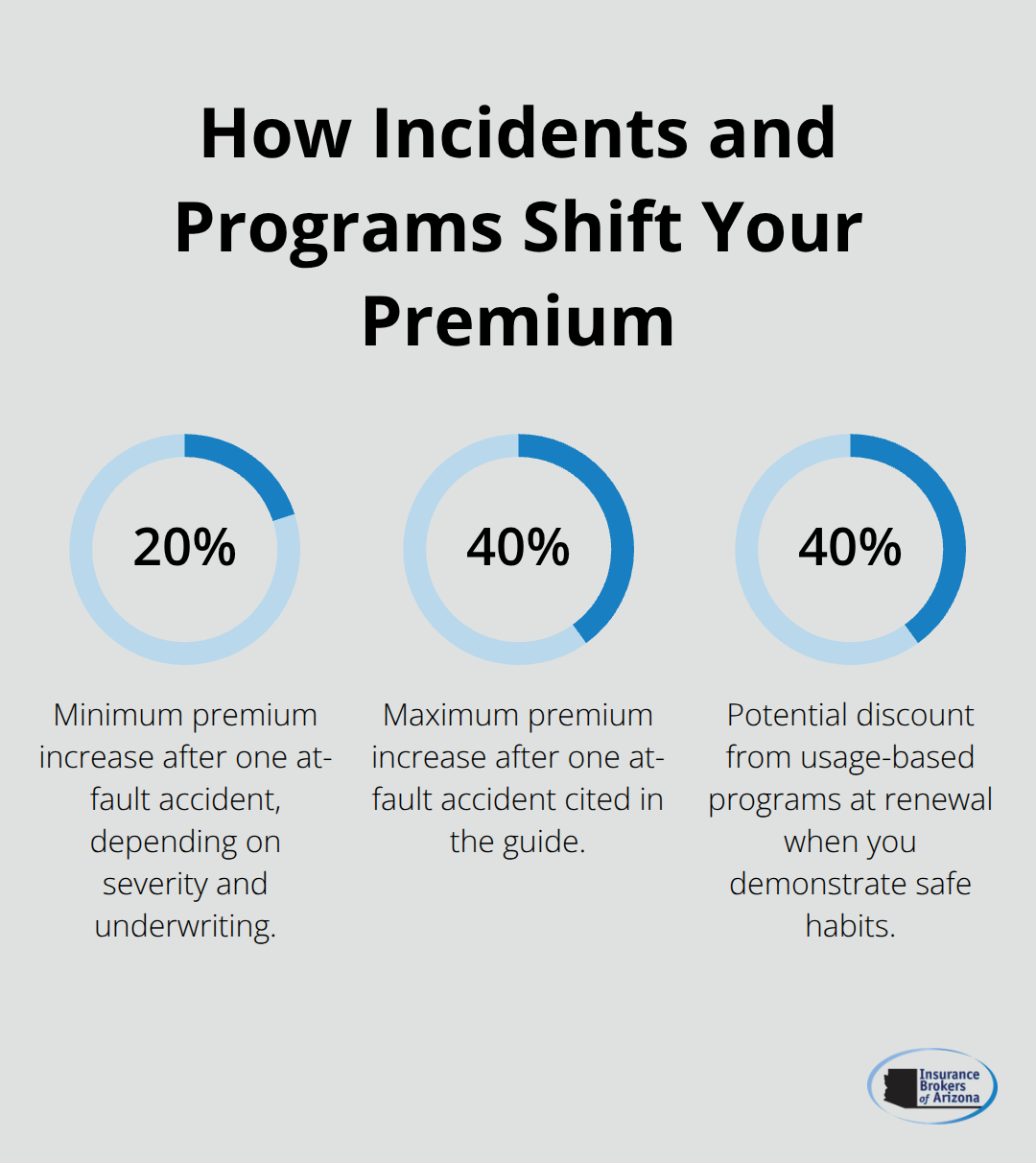
Your driver’s safety record stands as the single most influential factor determining your premiums, far outweighing vehicle age or coverage adjustments. Insurers scrutinize motor vehicle records intensely because accidents and violations directly predict future claims, and a single at-fault collision can increase your rates by 20 to 40 percent or force non-renewal entirely. Arizona commercial truck operators face even steeper penalties than standard auto drivers because truck accidents cause significantly higher damages and injuries.

Strict hiring standards that include multi-year motor vehicle record checks protect your rates from the start. Standardized onboarding with ride-alongs assesses driving behavior before drivers operate your fleet independently. Zero-tolerance policies for distracted driving or safety violations send clear expectations to your team. A fleet with five drivers maintaining clean records over three years typically saves $3,000 to $8,000 annually compared to operators with violation histories, making driver management your most cost-effective loss control investment.

Training and Accident Response Procedures Reduce Claims

Training programs focused on defensive driving, load securement, and accident avoidance reduce claims frequency measurably, though generic training yields minimal results. Your drivers need scenario-based instruction covering the specific roads and conditions they actually encounter in Arizona operations. Establish formal accident response procedures before incidents occur, requiring drivers to document scene details, preserve dashcam footage immediately, and report within specific timeframes so claims adjusters receive complete information.

Vehicle Maintenance and Fleet Age Impact Rates

Vehicle maintenance schedules and fleet age influence rates because well-maintained trucks experience fewer breakdowns and accidents than neglected equipment. Daily driver vehicle inspection reports should cover tire tread depth, brake responsiveness, and load securement, with maintenance issues addressed before they create safety hazards or trigger claims. Newer trucks with advanced safety features like automatic braking systems sometimes qualify for modest rate reductions, though insurers weight safety records far more heavily than vehicle age alone.

Deductibles, Operating Radius, and Cargo Type Control Costs

Your coverage limits and deductible choices directly control your out-of-pocket exposure and premium costs. Raising deductibles from $500 to $2,500 typically reduces your annual premium by 10 to 15 percent, but you’ll absorb that higher amount after each claim.

Percentage chart showing typical premium reductions when raising deductibles from $500 to $2,500. - Arizona commercial truck insurance

Most fleet operators find the sweet spot between $1,000 and $2,500 deductibles, balancing manageable out-of-pocket costs against meaningful premium savings.

Your operating radius matters substantially because regional routes within Arizona cost less to insure than multi-state operations, and cross-state travel exposes you to unfamiliar highways and higher accident risk. Cargo type directly influences your rates since transporting hazardous materials or high-value freight increases liability exposure dramatically compared to general freight operations.

Final Thoughts

Protecting your Arizona commercial truck insurance strategy means matching your coverage to actual operational exposures rather than accepting legal minimums that expose you to financial ruin. State minimums of $25,000 bodily injury and $15,000 property damage collapse when a single serious accident exceeds $500,000 in claims, which is why federal requirements demand $750,000 to $1,000,000 in combined single limit coverage. Your liability foundation, physical damage protection, cargo coverage, and uninsured motorist safeguards work together to shield your business from the financial devastation that one major claim inflicts.

The cost factors you control directly determine your premiums, with driver safety records mattering most and clean records saving $3,000 to $8,000 annually compared to violation histories. Strict hiring standards, scenario-based training, and formal accident response procedures reduce claims frequency measurably, while vehicle maintenance schedules and deductible choices between $1,000 and $2,500 balance protection against premium costs effectively. Your operating radius and cargo type shape rates substantially, making these operational decisions inseparable from your insurance strategy.

Arizona commercial truck insurance becomes manageable when you understand what protects your fleet and which adjustments genuinely reduce costs without sacrificing coverage. We at Insurance Brokers of Arizona® work with fleet owners across Arizona to match coverage limits to operational realities and identify premium savings through partnerships with reputable carriers. Contact us today for a personalized review of your current coverage and a competitive quote that reflects your specific fleet needs and safety record.

Disclaimer: The information provided in this blog is for general informational purposes only and does not constitute legal, financial, or insurance advice. Coverage options, terms, and availability may vary. Please consult with a licensed professional for advice specific to your situation.
Artisan contractors face unique risks that standard business insurance simply doesn’t cover. A single lawsuit or equipment damage can wipe out years of profit, which is why best practices for artisan contractor insurance matter so much.

We at Insurance Brokers of Arizona® have helped hundreds of contractors build protection strategies tailored to their specific trades. This guide walks you through the coverage gaps, risk management steps, and policy choices that actually protect your business.

What Coverage Do Artisan Contractors Actually Need

The Foundation: General Liability and Beyond

General Liability Insurance covers third-party bodily injury and property damage claims, but it leaves your tools, equipment, and vehicles exposed. Contractors often assume their GL policy protects everything on the jobsite, then lose $15,000 in power tools from a truck bed and find the policy doesn’t cover it. This gap appears repeatedly because standard GL policies focus on liability, not asset protection. Your GL policy simply won’t replace those losses, which is why additional coverage layers matter.

Protecting Tools and Equipment in Transit

Inland Marine Insurance specifically protects mobile tools and equipment in transit and at worksites, which is where most tool theft happens. Industry data shows tool theft ranks among the most financially damaging claims in construction because tools move between sites and sit in trucks or trailers overnight. A single theft can halt your project timeline and drain cash reserves. This coverage applies regardless of who drives the vehicle, protecting your assets during transport and at job locations.

Workers’ Compensation and Vehicle Coverage

Workers’ Compensation becomes legally required once you hire employees in most states, and it covers medical expenses, lost wages, and rehabilitation costs for injured workers. Many solo contractors skip this thinking they don’t need it, but the moment you bring on a crew member, you face significant liability without it. Commercial Auto Insurance is non-negotiable if you use company vehicles for work. Personal auto policies explicitly exclude business use, so a crash during a jobsite visit leaves you personally liable and uninsured.

Trade-Specific Premium Realities

Roofing contractors pay the highest premiums among trades, typically $150–$300 monthly for GL, because height-related fall hazards create substantial risk. Electricians average $85–$150 monthly for GL and roughly $217 monthly for Workers’ Comp, reflecting electrical shock and ladder fall exposures. Plumbers generally pay $75–$140 monthly for GL, though costs rise in flood-prone areas where water damage claims spike.

Monthly insurance premium ranges for roofing, electrician, and plumbing contractors in the U.S. - best practices for artisan contractor insurance

These ranges reflect the actual exposure levels your trade carries, not arbitrary pricing.

Addressing Coverage Exclusions and Overlaps

A Business Owner’s Policy bundles property and liability coverage at a lower cost than buying separately, but it still doesn’t address trade-specific exposures. Electrical contractors who perform design work need Professional Liability coverage, which costs roughly $50–$100 monthly and covers errors or omissions in plans. Plumbers who weld face coverage exclusions under standard plumbing policies because welding creates a separate fire and burn exposure that requires specific endorsement. Multi-trade contractors working alongside other trades create overlapping risk exposures that standard policies never account for. The solution isn’t buying maximum limits everywhere; it’s tailoring coverage to your actual work.

Managing Claims History and Future Protection

Experience Modification Rate heavily influences Workers’ Comp premiums. In New York, a 1.0 EMR is average, a 1.2 EMR raises premiums by about 20%, and a 0.8 EMR reduces them by about 20%, with claims staying on record for three years.

Chart showing premium changes at EMR 1.2 and 0.8 compared to average 1.0. - best practices for artisan contractor insurance

Proactive safety programs and documented training directly lower EMR and premiums. Umbrella Liability Insurance provides extra protection above your underlying policies and becomes increasingly important as projects grow in size and risk. The market for umbrella limits is tightening due to rising verdicts, so preparing now with strong primary coverage and documented risk controls positions you better than waiting until a major claim forces the issue. These layers of protection work together to address the real exposures your business faces, which is why selecting the right provider and understanding policy terms becomes your next critical step.

How to Lower Claims and Keep Your Business Running

Trade-Specific Safety Protocols Cut Claims and Premiums

Roofing contractors who implement formal safety training cut their Workers’ Comp claims by measurable amounts, directly lowering their Experience Modification Rate and future premiums. The data is clear: a 1.0 EMR in New York represents average risk, but contractors with documented safety programs regularly achieve 0.8 EMR or better, cutting premiums by approximately 20% over three years. A contractor with five employees paying $500 monthly in Workers’ Comp at a 1.0 EMR drops to roughly $400 monthly at 0.8 EMR, saving $600 annually just from one rate improvement.

Your trade-specific hazards demand targeted action. Electricians face electrical shock and ladder falls as their primary claim drivers; lockout-tagout procedures and harnesses on any work above six feet directly address these exposures. Plumbers encounter water damage liability and flood exposure; inspecting water lines before work starts and documenting site conditions prevent claims before they happen. Roofers working at height need fall protection systems that meet OSHA standards and documented proof that crews trained on those systems. The key is matching your safety protocols directly to your trade’s actual hazards, not adopting generic safety checklists that don’t apply to your work.

Documentation Transforms Safety Efforts Into Lower Premiums

Keep incident logs for every near-miss, every minor injury, and every safety observation on the jobsite. Carriers reviewing your renewal specifically look at these records to assess whether you actively manage risk or simply hope claims don’t occur. A contractor who reports three near-misses and implements corrective actions demonstrates stronger risk management than one who reports zero incidents, because zero often signals poor tracking rather than perfect safety.

Maintain tool inventories with serial numbers and photographs; when theft occurs, you’ll have proof for your Inland Marine claim rather than guessing at replacement costs. Store equipment in locked, secure locations and photograph storage setups to document your loss prevention efforts. Carriers offer premium discounts for documented safety features and controls, so comprehensive records directly reduce your costs. Your EMR, claims history, and safety documentation follow you across renewals and carriers, so investing in prevention now compounds into lower costs for years. A single major claim can spike your EMR for three years; preventing that claim through documented safety work costs far less than managing the aftermath.

Working With Advisors Who Understand Your Trade

Review your policies annually with a construction-focused advisor who understands your specific trade and project mix. A broker who serves electricians differently than roofers catches coverage gaps that generic advisors miss. Specialized programs exist precisely because artisan contractors need tailored solutions, not one-size-fits-all policies. Your advisor should ask about your specific work activities, the sites where you operate, and the equipment you use-not just offer standard templates. This level of attention reveals whether your current coverage actually protects your business or leaves dangerous gaps. When your broker understands roofing exposures, electrical work, or plumbing risks at a detailed level, they spot exclusions and overlaps that matter. The right partnership means your insurance adapts as your projects grow in size and complexity, keeping your protection aligned with your actual operations rather than falling behind market changes.

Finding the Right Broker for Your Trade

Premium Differences Demand Specialized Expertise

Comparing policies across carriers reveals a hard truth: premium differences for identical coverage swing 30–40% depending on the broker’s relationships and your trade specialization. A roofing contractor shopping solo might receive quotes from carriers that don’t understand fall protection work, pricing you as generic construction rather than specialized roofing. An independent broker with construction focus shops multiple carriers simultaneously, placing you with insurers who actively write roofing business and price accordingly.

Hub-and-spoke showing benefits of using a construction-focused insurance broker.

Insurance Brokers of Arizona® partners with over 40 carriers, which means we can match your specific trade to insurers who understand your exposures rather than forcing you into standard templates. The difference between a generic business insurance agent and a construction-focused broker isn’t small talk-it’s thousands of dollars in annual premiums and coverage gaps that won’t appear until you file a claim.

Questions That Separate Real Brokers From Template Pushers

Your broker should ask detailed questions about your specific work before quoting anything. Do you perform electrical design work, or only installation? Do your plumbers handle any welding? Are your crews working at heights exceeding six feet? These details determine which endorsements you actually need and which ones waste money. A broker who quotes you without understanding whether you’re a solo electrician or a roofing company with ten employees is simply pulling templates. Request quotes that itemize each coverage type with limits and deductibles clearly stated, allowing you to compare actual protection rather than total premium figures. Avoid brokers who push umbrella coverage without reviewing your primary policies first-umbrella insurance only works when your underlying general liability, workers’ compensation, and commercial auto policies have strong limits and documented risk controls. Ask about Experience Modification Rate discounts and whether the carrier offers premium credits for documented safety training, because these reductions compound significantly over three years.

Reading Policy Language Catches Hidden Exclusions

Red flags appear quickly when you read policy language carefully. Exclusions for specific trades hide in endorsement sections, not in marketing materials. A plumbing policy excluding welding work means any claim involving heat or flame gets denied, even if welding was incidental to the main work. Request the actual policy documents before purchase, not summaries or brochures, and have your broker explain what each exclusion means for your specific projects. If a carrier’s policy excludes multi-trade overlaps or subcontractor work, that exclusion will haunt you the moment a claim involves another trade on the jobsite. Vague language around coverage territory matters too-if your policy covers work within Arizona only, you’re uninsured the moment you cross state lines.

Matching Certificates of Insurance to Actual Coverage

General contractors often require subcontractors to maintain specific policy limits and endorsements; your broker must confirm your actual policy matches what you promised on certificates of insurance, because mismatches create claim denials when you need protection most. Deductibles deserve equal scrutiny-a $2,500 deductible sounds reasonable until you file a claim and realize you’re paying that amount out of pocket repeatedly. Compare deductible levels across your entire package, because bundling policies often allows you to adjust deductibles strategically, reducing your highest-risk coverage to $1,000 while increasing lower-risk coverage to $2,500, lowering total premiums without sacrificing critical protection.

Final Thoughts

Best practices for artisan contractor insurance come down to matching your coverage to your actual work, not to generic templates that miss your trade’s specific exposures. You’ve learned that general liability alone leaves your tools unprotected, that workers’ compensation becomes legally required the moment you hire employees, and that trade-specific exclusions hide in policy language until a claim forces them into the open. The contractors who avoid catastrophic losses understand their exposures, document their safety efforts, and work with advisors who actually know their trade.

Contact a construction-focused broker who can review your current policies against your actual work activities and bring your project details, equipment inventory, and crew size to that conversation. Ask whether your coverage addresses tool theft, whether your workers’ compensation reflects your current payroll, and whether your commercial auto policy covers all vehicles you use for business. Request itemized quotes that show each coverage type with limits and deductibles clearly separated, not bundled totals that hide what you’re actually buying.

Contractors who implement documented safety programs lower their Experience Modification Rate and cut workers’ compensation premiums by 20% or more over three years, with those savings compounding annually. Contact Insurance Brokers of Arizona® today to review your coverage and identify the gaps that could derail your business, since we work with over 40 carriers to match your specific trade to insurers who understand your exposures rather than forcing you into standard templates.

Disclaimer: The information provided in this blog is for general informational purposes only and does not constitute legal, financial, or insurance advice. Coverage options, terms, and availability may vary. Please consult with a licensed professional for advice specific to your situation.