Your commercial truck insurance down payment is often the first hurdle when securing coverage. The amount you’ll pay upfront depends on several factors-from your vehicle type to your driving record.

At Insurance Brokers of Arizona®, we’ve helped countless truck operators understand what drives these costs and how to reduce them. This guide walks you through the key factors affecting your down payment and practical strategies to lower it.

What Drives Your Down Payment

Vehicle type matters far more than most operators realize. A newer refrigerated truck with advanced safety technology will command a lower down payment than an older dry van, even if both operators have identical driving records. Refrigerated units typically cost 15–25% more in annual premiums than standard equipment, which means your down payment scales accordingly. Hazmat carriers face the steepest upfront costs because the FMCSA requires $5 million in liability coverage for hazardous materials, pushing annual premiums into the $18,000–$25,000 range and down payments to $3,000–$6,000. The cargo type you haul also influences risk assessment: general freight costs less, while oversized loads or car hauling can nearly double your insurance costs since they expose insurers to higher liability exposure. If you operate within a 0–300 mile radius, your down payment will be substantially lower than someone running 500+ miles, because longer routes increase accident probability and claims frequency.

Infographic showing the main drivers that influence a commercial truck insurance down payment in the United States.

How Your Driving Record Shapes What You Pay Upfront

Your motor vehicle record is the single most predictive factor for down payments. New authority operators typically face down payments of 15–25% of annual premiums because underwriters view them as unproven, while experienced drivers with clean records pay closer to 10–15%. A single violation or out-of-service finding from roadside inspections can spike your entire premium by thousands of dollars in a single renewal cycle. This means your down payment can jump by $500–$1,500 overnight if your safety record deteriorates. Conversely, operators with 3+ years of clean operation unlock access to carriers like Great West, Northland, and National Indemnity that offer substantially lower down payments than Progressive or OOIDA. Your DOT safety score matters year-round, not just at renewal, so maintaining your SMS score directly protects your down payment from unexpected increases.

Coverage Choices and Their Upfront Cost Impact

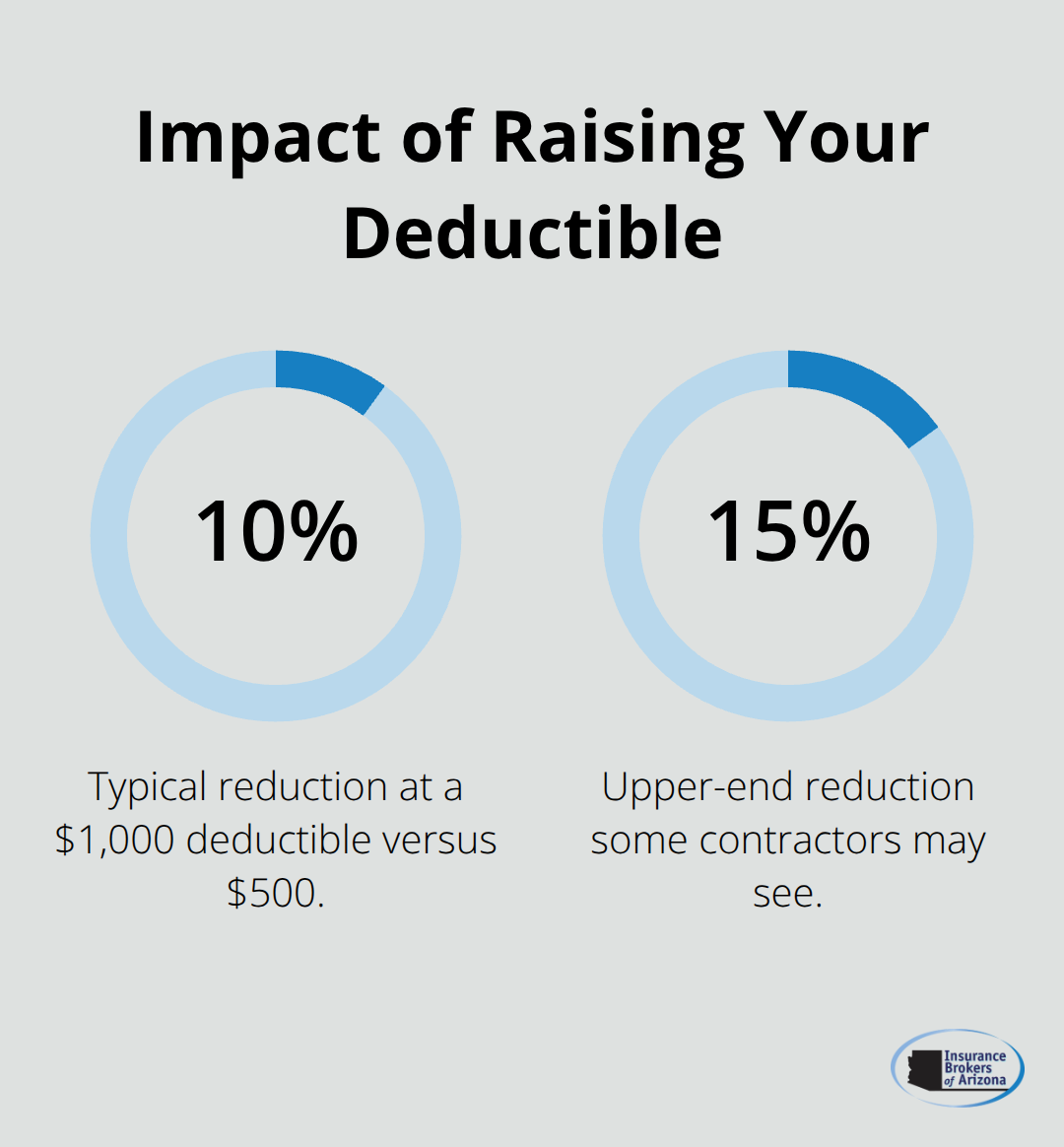
The deductibles you select have immediate consequences for your initial payment. Raising your collision deductible from $1,000 to $2,500 can reduce your annual premium by 15–25%, which proportionally lowers your down payment. A $1,500–$3,000 annual savings translates directly into $150–$450 less due upfront. Coverage limits also matter: most owner-operators carry $1 million in liability even though FMCSA minimums are $750,000, because shippers and brokers increasingly require the higher limit. That $250,000 extra in liability coverage will add roughly $400–$800 to your annual premium and $40–$120 to your down payment. Combining multiple coverages with a single carrier yields measurable savings that reduce your overall down payment; operators who combine primary liability, cargo, physical damage, and bobtail coverage with one insurer often save 10–15% on the total package compared to splitting coverage across multiple carriers.

Why Operating Radius Affects Your Initial Costs

Your operating radius directly influences how underwriters assess your risk profile. Carriers that restrict you to local or regional routes (0–300 miles) view you as lower risk than operators who cross state lines or run nationwide. This difference translates into down payment reductions of 10–20% for local operators. If you shift your operations or expand your service area, you must update your FMCSA filings and verify your ELD data to avoid surcharges or disputes at renewal. Underwriters will recalculate your premium and down payment based on your new radius, so transparency about your actual routes matters significantly.

How New Authority Status Impacts Your Upfront Costs

New authority operators face a distinct penalty in the insurance market. Underwriters lack a track record to evaluate, so they apply higher down payment percentages and stricter underwriting standards. After two to three years of clean operation, you gain access to more carriers and lower down payment thresholds. This progression means your down payment can drop by 30–40% once you move from new authority status to established operator status. The carriers that accept new authority business (Progressive and OOIDA) typically require higher down payments than the carriers that emerge after year three (Great West, Northland, National Indemnity). Understanding this timeline helps you plan your cash flow and anticipate when your down payment obligations will decrease.

Your down payment is just the first step toward securing the right coverage. The next section explores practical strategies to reduce that initial payment and find the coverage that actually matches your operation.

How to Cut Your Down Payment Without Cutting Coverage

Bundle Your Policies for Immediate Savings

Bundling your policies with a single carrier reduces your down payment immediately. Operators who combine primary liability, cargo, physical damage, and bobtail coverage under one insurer typically save 10–15% on their total annual premium, which translates directly into a lower upfront payment. A $12,000 annual premium becomes roughly $10,200 after bundling, dropping your down payment from $1,800 to $1,530 if you pay 15% upfront.

Compact checklist of steps U.S. truck operators can take to reduce commercial truck insurance down payments.

Lock in the relationship for at least two years, because carriers reward multi-year commitments with stability and better renewal terms. When you shop for quotes, ask carriers explicitly whether they offer bundling discounts and what the total cost looks like across all coverages combined, not just primary liability in isolation.

Many operators waste money by pricing liability separately from cargo and physical damage, then assembling coverage piecemeal across three different insurers. That fragmented approach costs more upfront and at renewal because you lose the bundling advantage entirely.

Strengthen Your Safety Record Before Renewal

Your motor vehicle records and driver qualification files are the second lever you control. Pull fresh MVRs for every driver 90–120 days before renewal and conduct a mini-audit of your driver files (medical cards, employment verification, drug and alcohol testing records). This signals to underwriters that you take compliance seriously. Fleets that document this proactive approach often qualify for safety discounts of 2–5% on liability premiums, which reduces your down payment by $200–$600 annually.

Installing forward-facing dashcams, telematics systems, automatic braking, or lane departure warnings can lower liability premiums by up to 6% because you demonstrate measurable risk reduction. One fleet cut liability premiums by 6% specifically by documenting forward collision avoidance system installations to their carrier before renewal. These investments cost $2,000–$5,000 upfront but pay for themselves within a year through lower premiums and smaller down payments.

Plan Your Renewal Timeline to Gain Negotiating Power

Start your renewal planning 90–120 days ahead rather than waiting until the last 30 days. This gives you negotiating leverage because carriers know you’re not desperate. Waiting until the final month forces you to accept overpriced offers and higher down payment requirements because underwriters recognize you have no alternatives.

Compare Quotes from Multiple Carriers

Comparing quotes from at least three carriers is non-negotiable, yet most operators solicit only one or two quotes before committing. Each carrier weights your risk factors differently, meaning the same driver, truck, and operation can generate vastly different premium quotes and down payment structures. One carrier might require 20% down while another accepts 10% down for identical coverage, simply because their underwriting appetite differs.

Progressive and OOIDA dominate the new authority market but rarely offer the lowest down payments once you have 2–3 years of clean operation. After that threshold, carriers like Great West, Northland, and National Indemnity become available and frequently quote 15–30% lower premiums than the carriers that initially accepted your new authority business. The down payment savings compound over time, so a $2,000 reduction in annual premium saves you $300 in down payment costs immediately and $300 annually thereafter.

Request explicit down payment percentages and financing options from each carrier, not just total premium figures, because some carriers offer 10% down while others demand 25% regardless of credit or driving history. An experienced broker can access multiple carriers simultaneously and present side-by-side comparisons that show total cost of ownership, not just the monthly payment or annual premium in isolation.

Your down payment strategy sets the foundation for sustainable coverage costs, but the coverage itself must match your actual operation. The next section examines the specific liability requirements and specialized coverages that protect your business from the risks you actually face.

What Coverage Do You Actually Need

FMCSA minimums exist as a legal baseline, not as adequate protection for your operation. The federal requirement sits at $750,000 in liability for general freight over 10,001 lbs, but most shippers and brokers now require $1 million as a condition of load acceptance. That $250,000 gap matters: it adds roughly $400–$800 to your annual premium, which translates to $40–$120 on your down payment. Hazmat carriers face a completely different threshold at $5 million in liability coverage because the risk exposure is exponentially higher. New authority operators commonly carry $1 million in liability even when $750,000 would satisfy FMCSA requirements, because carriers know that a single nuclear verdict can exceed federal minimums by millions. In 2024, nuclear verdicts surged 52% year-over-year, with median verdicts reaching $51 million and thermonuclear awards exceeding $100 million in 49 cases. This means the $250,000 difference between federal minimum and industry standard is not optional-it is the difference between catastrophic personal liability and manageable risk.

Percentage highlights affecting commercial trucking insurance costs in the U.S.

Physical Damage Protects Your Equipment Investment

Physical damage coverage splits into collision and comprehensive, and your choice depends on whether you own or finance your truck. If your rig is financed, the lender requires physical damage coverage as a loan condition. Owner-operators typically pay $1,000–$3,000 annually for physical damage, with collision deductibles ranging from $500 to $2,500. Raising your collision deductible from $1,000 to $2,500 cuts your annual premium by 15–25%, saving $150–$450 upfront on your down payment. However, this strategy works only if you have cash reserves to cover the higher deductible after a loss. Comprehensive coverage protects against theft, weather, and vandalism and costs significantly less than collision-often $400–$800 annually. Many operators skip comprehensive on older paid-off trucks, but if you operate in high-theft urban areas or park overnight in exposed lots, that decision can backfire. Garage storage reduces your comprehensive premium by 10–15% because insurers view secure facilities as lower risk than outdoor parking, so if you have access to a covered lot, inform your carrier before renewal.

Specialized Coverage Matches Your Actual Cargo and Operations

Cargo insurance cost depends entirely on freight value and load type. General freight runs $400–$800 annually, but refrigerated units cost 15–25% more because temperature-controlled equipment represents higher equipment value and spoilage risk. Hazmat cargo requires separate underwriting and pushes annual premiums to $18,000–$25,000 or higher depending on the hazard class. The FMCSA defines nine hazmat classes-explosives, gases, flammable liquids, flammable solids, oxidizers, poison, radioactive materials, corrosives, and miscellaneous-and each class carries different underwriting scrutiny and premium structures. Car hauling nearly doubles insurance costs in some cases because vehicles represent high-value cargo with elevated loss frequency. Oversized load permits trigger additional coverage requirements and premium adjustments because they increase your liability exposure on public roads.

Additional Coverages That Close Protection Gaps

Non-trucking liability covers you during personal use when you operate without dispatch, and costs $350–$480 annually-this coverage is critical because your primary liability policy excludes personal use. Bobtail coverage applies when you operate a tractor without a trailer and costs $350–$480 annually. Many owner-operators skip bobtail coverage until they need it, then discover they have operated illegally. Occupational accident insurance provides income replacement if you suffer injury and cannot work, costing $1,600–$2,200 annually, and is strongly recommended for independent operators since you lack workers compensation protection. Uninsured and underinsured motorist coverage protects you if another driver causes an accident without adequate insurance. Downtime coverage reimburses lost income while your truck sits in the shop after a covered loss. Rental reimbursement covers the cost of a substitute vehicle during repairs. Trailer interchange coverage protects you when you haul trailers you do not own. Umbrella liability extends your protection beyond standard policy limits and typically costs $500–$700 annually for $1 million in additional coverage.

Bundle Coverage to Reduce Total Cost

Bundling cargo, bobtail, and occupational accident with your primary liability saves 10–15% compared to purchasing these coverages separately, so request combined pricing from your carrier before committing to a single policy. A $12,000 annual premium drops to roughly $10,200 after bundling, which reduces your down payment proportionally. Lock in the relationship for at least two years, because carriers reward multi-year commitments with stability and better renewal terms. When you shop for quotes, ask carriers explicitly whether they offer bundling discounts and what the total cost looks like across all coverages combined, not just primary liability in isolation. Many operators waste money by pricing liability separately from cargo and physical damage, then assembling coverage piecemeal across three different insurers. That fragmented approach costs more upfront and at renewal because you lose the bundling advantage entirely.

Final Thoughts

Your commercial truck insurance down payment hinges on three controllable factors: your safety record, your coverage choices, and your renewal timeline. New authority operators typically pay 15–25% down because underwriters lack a track record, but this penalty disappears after two to three years of clean operation. Experienced drivers with solid motor vehicle records qualify for down payments as low as 10–15%, while violations or out-of-service findings spike your upfront costs by $500–$1,500 overnight.

Reducing your down payment without sacrificing protection requires three concrete actions. Bundle your policies with a single carrier to save 10–15% on total premiums, which translates directly into lower upfront payments. Strengthen your safety record by pulling fresh motor vehicle records 90–120 days before renewal and install forward-facing dashcams or telematics-these investments cut liability premiums by 2–6% and signal reduced risk to underwriters.

Start your renewal process 90–120 days early and compare quotes from at least three carriers, because each underwriter weights your risk differently and may offer substantially lower down payment percentages for identical coverage. Contact Insurance Brokers of Arizona® to access partnerships with over 40 reputable carriers and receive side-by-side comparisons that show total cost of ownership. Request explicit down payment percentages and financing options from each carrier, then ask about bundling discounts and multi-year commitment rewards.

Disclaimer: The information provided in this blog is for general informational purposes only and does not constitute legal, financial, or insurance advice. Coverage options, terms, and availability may vary. Please consult with a licensed professional for advice specific to your situation.
Many homeowners ask us whether hazard and home insurance are the same thing. The short answer is no-they’re different types of coverage that protect different aspects of your property.

At Insurance Brokers of Arizona®, we’ve found that confusion between these two policies often leaves homeowners underinsured. Understanding what each covers will help you make better decisions about protecting your home and finances.

What Hazard Insurance Covers and Why Lenders Demand It

Hazard insurance protects your home’s physical structure from specific perils. Your mortgage lender requires this coverage as a condition of your loan, which is why understanding what it actually protects matters so much. Hazard insurance covers fire, lightning, hail, windstorms, theft damage to the structure, vandalism, explosions, weight of ice and snow, riots, and damage from vehicles or fallen trees hitting your home.

List of hazards typically covered by standard hazard insurance policies - is hazard and home insurance the same

What Hazard Insurance Excludes

Standard hazard policies exclude floods, earthquakes, mold, wear and tear, and neglect. These gaps matter because they leave your home vulnerable to common risks in certain regions. If you live in a flood-prone area or earthquake zone, you’ll need separate policies to fill these holes. According to Bankrate data from July 2025, the average homeowners insurance cost with $300,000 in dwelling coverage runs about $2,466 per year, though your actual premium depends heavily on your location, home age, construction type, and deductible choice.

What Happens When You Skip Hazard Insurance

Your mortgage lender requires hazard insurance, period. If you fail to maintain it, lenders purchase forced-place insurance on your behalf, which costs significantly more and provides minimal coverage. This forced-place option is far more expensive than selecting your own policy, making it financially foolish to let coverage lapse.

Hazard Insurance for Homeowners Without Mortgages

If you own your home outright, no lender mandate exists, yet hazard coverage remains a smart protection for your investment. Premiums vary considerably by location, with coastal hurricane zones and wildfire-prone areas seeing substantially higher rates because insurers price coverage based on actual risk data.

How Your Deductible Affects Your Premium

Your deductible choice directly affects your premium, so raising it from $500 to $1,000 or $1,500 can lower your annual costs (provided you have emergency savings to cover the higher out-of-pocket expense when filing a claim). Location, home construction, and your claims history all influence what you pay. Understanding these factors helps you compare quotes effectively and find coverage that fits your budget and risk tolerance.

What Home Insurance Actually Covers

Home insurance is fundamentally broader than hazard insurance because it combines dwelling protection with personal property coverage and liability protection into one comprehensive policy. Where hazard insurance focuses exclusively on your home’s structure, home insurance protects your belongings inside that structure and shields you financially if someone gets injured on your property and sues.

Hub-and-spoke showing home insurance components and what each protects - is hazard and home insurance the same

How HO-3 Policies Work

Most homeowners purchase an HO-3 policy, the standard market option that uses open-peril coverage for the dwelling (meaning it covers all perils except those specifically excluded) while using named-peril coverage for your personal property (meaning it covers only the specific perils listed in the policy). This distinction matters practically because your furniture, electronics, and clothing operate under different rules than your roof and walls.

Personal Property Coverage Limits

Personal property coverage typically runs at 50 to 70 percent of your dwelling limit, so if your home’s structure is insured for $300,000, your belongings might be covered for $150,000 to $210,000. You should adjust this percentage based on what you actually own, not what an insurance company suggests. High-value items like jewelry, art, or expensive electronics often need separate endorsements called floaters because standard policies cap coverage on certain categories.

Liability Protection and Umbrella Policies

Personal liability coverage protects you when someone is injured at your home and holds you responsible. According to Bankrate’s 2025 data, liability limits typically range from $100,000 to $300,000 depending on your assets and risk profile. Most people with significant savings or investments should carry at least $300,000 in liability protection, and many financial advisors recommend adding an umbrella liability policy that provides an additional $1 million or more in coverage for roughly $150 to $300 annually.

Additional Living Expenses Coverage

Additional living expenses coverage activates if a covered peril forces you to leave your home during repairs, paying for hotel stays, restaurant meals, and other necessary costs while your home is being restored. This protection matters because reconstruction timelines can stretch months, and without this coverage, you absorb those living costs yourself while also paying your mortgage or rent. These gaps between what hazard insurance covers and what home insurance provides create significant financial exposure that many homeowners overlook until they face a loss.

Hazard vs Home Insurance: What Actually Differs

Hazard insurance and home insurance operate under completely different financial structures, which is why comparing their costs side-by-side misleads most homeowners. Hazard insurance isn’t a separate line item you purchase independently; it’s the dwelling protection component bundled inside your homeowners policy. When you see that average homeowners insurance costs $2,466 annually according to Bankrate’s July 2025 data for $300,000 in dwelling coverage, that figure includes hazard protection plus personal property coverage, liability protection, and additional living expenses. The hazard portion alone represents roughly 60 to 70 percent of your total premium, meaning the structural protection costs somewhere between $1,480 and $1,726 annually in that example.

Chart showing the hazard share of the total homeowners insurance premium

Location drives massive premium variations, with coastal hurricane zones paying 40 to 60 percent more than inland areas because actual loss data shows higher risk. If you live in a high-risk wildfire zone in Arizona, your premium will exceed national averages substantially. Your deductible choice creates the most direct cost control: raising it from $500 to $1,500 typically reduces premiums by 15 to 25 percent, but only if you maintain emergency savings to cover that higher out-of-pocket expense when filing a claim.

Why Lenders Mandate Hazard Coverage

Your mortgage lender mandates hazard insurance specifically because they hold a financial interest in your home. They don’t care whether you have personal property coverage or liability protection; they only require that the structure itself is insured at replacement cost so the mortgage can be paid off if your home burns down. This legal requirement means forced-place insurance becomes your reality if you let hazard coverage lapse, and that lender-purchased coverage costs 50 to 100 percent more than standard policies while providing minimal protection.

Home insurance, by contrast, protects you and your financial assets rather than satisfying a lender’s requirement. This distinction explains why owning your home outright changes the insurance conversation entirely: without a lender mandate, hazard coverage becomes optional rather than mandatory, though it remains financially prudent for anyone carrying a significant asset.

The Personal Property Protection Gap

Hazard insurance covers your home’s structure but ignores your belongings completely, creating a dangerous gap that most homeowners don’t recognize until after a loss occurs. If a fire destroys your home, hazard insurance rebuilds the structure while your personal property coverage compensates for furniture, electronics, and clothing inside that structure. Without home insurance’s personal property component, you lose everything you own inside the burned home with zero compensation.

Liability Protection You Cannot Ignore

Liability protection matters equally: if someone slips on your icy driveway and sues for $500,000 in medical bills, hazard insurance provides nothing because it covers only the structure. Home insurance’s liability component protects you in that scenario, and most people carrying significant assets should add umbrella liability coverage providing $1 million or more in additional protection for $150 to $300 annually. This structural protection versus comprehensive protection distinction is absolute: hazard insurance alone leaves you financially exposed in ways that home insurance prevents.

Final Thoughts

Is hazard and home insurance the same? No-hazard insurance covers only your home’s structure against specific perils like fire, wind, and hail, while home insurance bundles that structural protection with personal property coverage and liability protection. Your mortgage lender requires hazard coverage because they have a financial stake in your home, but home insurance protects you and your assets from losses that hazard coverage alone cannot address.

The gaps between these two policies create real financial exposure that affects your wallet directly. Hazard insurance leaves your personal belongings completely unprotected, meaning a fire that destroys your home also destroys everything inside it with zero compensation from hazard coverage. Liability protection matters equally: if someone sues you for injuries sustained at your home, hazard insurance provides nothing because it covers only the structure, so most homeowners carrying significant assets should add umbrella liability coverage providing $1 million or more in additional protection for roughly $150 to $300 annually.

Your specific situation determines what coverage you actually need, and shopping around produces meaningful savings. If you carry a mortgage, your lender mandates hazard insurance, and skipping it triggers forced-place insurance that costs 50 to 100 percent more while providing minimal protection. We at Insurance Brokers of Arizona® work with over 40 reputable carriers to find coverage that matches your specific needs and budget, so contact us today for a personalized assessment that identifies gaps and secures competitive rates tailored to your situation.

Disclaimer: The information provided in this blog is for general informational purposes only and does not constitute legal, financial, or insurance advice. Coverage options, terms, and availability may vary. Please consult with a licensed professional for advice specific to your situation.
Getting your first car is exciting, but auto insurance for new drivers can feel overwhelming. You’re facing unfamiliar terms, coverage options, and decisions that directly impact your wallet and protection on the road.

At Insurance Brokers of Arizona®, we’ve helped countless young drivers navigate these choices and find policies that actually fit their needs and budgets. This guide breaks down everything you need to know in plain language.

What Coverage Do You Actually Need

Arizona’s Liability Requirements and Why Minimums Fall Short

Arizona requires liability insurance before you drive legally, and that’s the foundation every new driver must understand. Liability coverage pays for damage or injuries you cause to others, and Arizona’s minimum is 15/30/10-meaning $15,000 per person and $30,000 per accident for bodily injury, plus $10,000 for property damage. That’s the legal floor, but it’s dangerously low. A single accident can easily exceed these limits, leaving you personally responsible for thousands in damages.

We recommend 100/300/100 coverage as a realistic target that actually protects your assets without excessive cost. Most new drivers underestimate how quickly medical bills and vehicle repairs climb after an accident.

Collision and Comprehensive: When You Need Them

Beyond liability, you need to evaluate collision and comprehensive coverage based on your specific situation. If you financed or leased your vehicle, your lender requires both collision and comprehensive, so you don’t have a choice. If you own the car outright, the decision depends on its value and your ability to replace it.

Collision covers damage from accidents, while comprehensive handles theft, weather, vandalism, and other non-collision events. Your premium gets calculated using your age, driving record, vehicle type, location, and the coverage limits you choose.

Key factors that influence a new driver’s auto insurance premium in the United States - auto insurance for new driver

Deductibles and Optional Coverage

A higher deductible reduces your monthly payment but increases what you’ll pay out-of-pocket if you file a claim. The math is straightforward: a $1,000 deductible costs less monthly than a $250 deductible, but you need funds available if something happens. New drivers should also consider optional coverages like roadside assistance and rental reimbursement, which add modest monthly costs but prevent major headaches when your car breaks down or gets damaged.

How Vehicle Type and Location Shape Your Costs

Your vehicle choice matters significantly. Insuring a used Mazda MX-5 Miata costs roughly $2,640 annually for a teen, while a Subaru Outback runs about $2,735, according to insurance data. Sports cars and luxury vehicles cost substantially more due to higher repair costs and theft risk.

Location shapes your baseline costs regardless of coverage choices. The least expensive states for young drivers include Iowa at around $1,613 annually and Alabama at $2,274. According to Forbes Advisor data, the typical cost to add a 16-year-old to a parent’s policy runs about $2,408 annually, but this varies dramatically by state and carrier. Louisiana averages around $5,468 for a teen, while North Carolina sits closer to $2,312.

Finding Your Coverage Sweet Spot

The coverage you select directly determines what you’ll pay each month and what protection you actually have when an accident happens. Your next step involves shopping for quotes from multiple carriers to see how different coverage combinations affect your premium. Each insurer prices risk differently, and the quotes you receive will reveal which carriers offer the best value for your specific situation.

How to Shop for Quotes and Lock in Real Savings

Request Quotes from Multiple Carriers

Getting multiple quotes stands as the single most effective way to find affordable coverage, yet most new drivers skip this step entirely. When you request quotes from different carriers, provide identical information across all applications so you’re comparing apples to apples. Your age, driving record, vehicle details, ZIP code, and coverage selections all influence the final price, so consistency matters.

According to Forbes Advisor data, the average cost to add a 16-year-old to a parent’s policy ranges from $2,993 with Nationwide to $4,885 with Travelers, but these figures shift dramatically based on your specific situation and state. A new driver in North Carolina might pay around $2,312 annually, while the same driver in Louisiana could face $5,468. This state-level variation means your location determines a baseline cost that no discount eliminates, but your carrier choice absolutely does.

Request quotes from at least three to five different insurers using the same deductible and coverage limits. Online quote tools work quickly, but speaking directly with a licensed representative often reveals discounts you’d miss on a website.

Stack Discounts to Reduce Your Premium

Many insurers offer away-at-school discounts up to 20 percent if you attend college away from home, good student discounts around 3 to 7 percent for maintaining solid grades, and driver training discounts through programs like State Farm Steer Clear or Hanover SmartPath. These discounts compound, so a new driver with good grades who completed a defensive driving course might reduce their annual premium by 10 to 15 percent simply through stacking available reductions.

Common auto insurance discounts for U.S. new drivers and typical savings ranges

Choose the Right Vehicle and Policy Structure

A used Mazda MX-5 Miata runs approximately $2,640 annually for a teen driver, while a Subaru Outback costs around $2,735, making older vehicles with strong safety ratings dramatically cheaper to insure than new sports cars. If your family has multiple vehicles, adding the teen driver to the parent’s policy on the least expensive car saves hundreds annually compared to insuring them on a newer or higher-value vehicle.

Bundling auto insurance with home or renters coverage typically yields multi-policy discounts ranging from 10 to 25 percent depending on the carrier. Usage-based insurance programs that monitor your driving habits through a mobile app can reward safe driving with lower premiums, though new drivers should verify upfront that the program offers a guaranteed discount rather than risking rate increases for normal teenage driving patterns.

Protect Yourself with Strategic Coverage Choices

Accident forgiveness coverage prevents your rate from jumping after your first at-fault accident, protecting you from the typical 20 to 40 percent premium increase that follows a claim. Higher deductibles directly lower monthly payments, but only choose a $1,000 or $500 deductible if you have that amount available in savings for an emergency claim.

Shopping around when adding a teen to an existing policy often reveals that switching carriers entirely saves more money than staying with your current insurer, even after accounting for loyalty discounts. Obtain fresh quotes every two to three years regardless of your current coverage, as carrier pricing shifts and new discounts emerge regularly. Once you’ve narrowed your options and selected a carrier, the next critical step involves understanding exactly what your policy covers and what it doesn’t before you sign the paperwork.

What New Drivers Get Wrong About Coverage

Selecting Insufficient Liability Limits

Most new drivers make their first critical mistake before they even start shopping: they assume Arizona’s minimum liability limits provide adequate protection. The 15/30/10 requirement satisfies the law, but it leaves you financially exposed. A single accident involving injuries can generate medical bills exceeding $30,000 in minutes, and you’ll owe the difference personally. Forbes Advisor data shows that recommended coverage sits at 100/300/100, yet many new drivers stick with minimums because they don’t understand the real-world cost of underinsurance. You might save $30 monthly with lower limits, but one accident costs you tens of thousands.

Skipping the Policy Document Review

The second mistake happens at the point of purchase: new drivers skip reading their actual policy documents entirely. They glance at a quote summary, see a price they can afford, and click purchase without understanding what their deductible actually means, which optional coverages they selected, or what exclusions apply. Your policy document contains the precise details that determine what happens when you file a claim-not the marketing materials or quote confirmation. Many insurers include coverages you didn’t request and exclude situations you thought were covered. Spend 20 minutes reading your declarations page and coverage section before finalizing anything.

Failing to Update Information After Purchase

The third mistake involves ignoring the need to update information after you purchase a policy. New drivers change addresses, add roommates, modify their vehicle, or pick up traffic violations, then fail to notify their insurer. Some assume they’re locked in at the quoted rate; others simply forget. When you eventually file a claim and the insurer discovers you misrepresented your situation-whether intentionally or through oversight-they can deny coverage entirely or cancel your policy. Arizona insurers take material misrepresentation seriously, and the consequences far exceed the premium you saved by not updating your information.

Taking Action on Life Changes

A move to a higher-crime ZIP code, adding a second driver to your household, or installing new safety features all affect your rate and coverage eligibility. Contact your insurer within 30 days of any significant life change, and request a new quote to see whether your rate should adjust. These three mistakes compound: insufficient coverage leaves you unprotected, skipping the policy review means you don’t realize what’s missing, and failing to update information creates gaps that emerge exactly when you need coverage most.

Three common new-driver insurance mistakes with practical fixes - auto insurance for new driver

Final Thoughts

Auto insurance for new drivers requires three critical decisions: selecting adequate coverage limits, understanding your policy details, and maintaining accurate information with your insurer. You’ve now seen why Arizona’s minimum liability limits leave you financially exposed, how to shop effectively across multiple carriers, and which mistakes derail new drivers before they even start driving. The difference between a policy that protects you and one that leaves you vulnerable often comes down to spending time on these fundamentals rather than rushing through the process.

Gather your driver’s license, vehicle information, and driving history, then request quotes from at least three to five different insurers using identical coverage selections. Compare the quotes side by side, stack available discounts like good student or away-at-school reductions, and select a carrier that balances affordability with strong claims handling. Once you’ve chosen a policy, read your declarations page and coverage section before finalizing anything.

Professional guidance matters because insurance brokers understand how different carriers price risk and which discounts apply to your specific situation. Contact Insurance Brokers of Arizona® to have a licensed representative compare options for you and explain exactly what each policy covers. New drivers benefit enormously from having someone explain the real-world implications of coverage choices instead of making decisions based on price alone.

Disclaimer: The information provided in this blog is for general informational purposes only and does not constitute legal, financial, or insurance advice. Coverage options, terms, and availability may vary. Please consult with a licensed professional for advice specific to your situation.