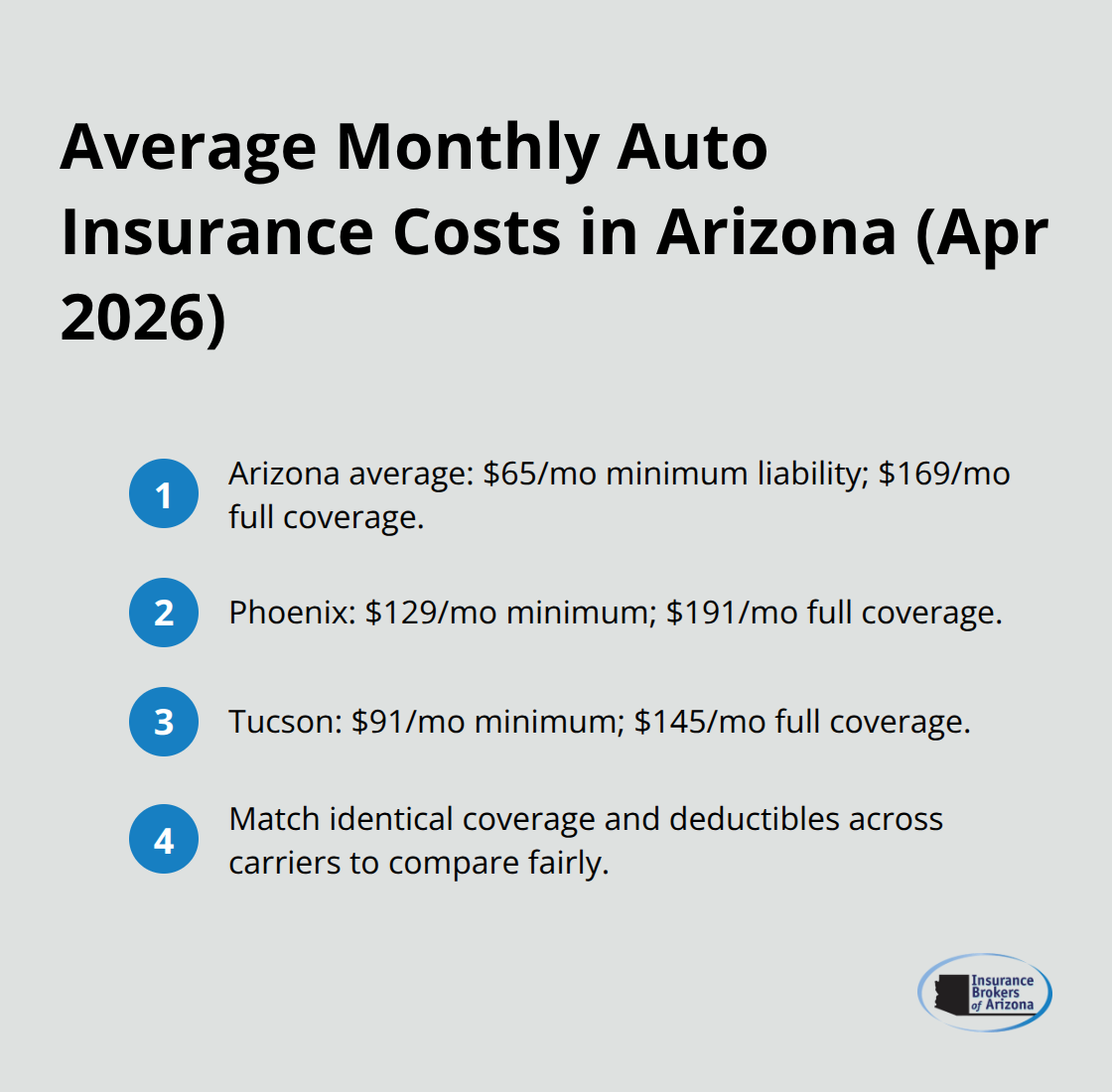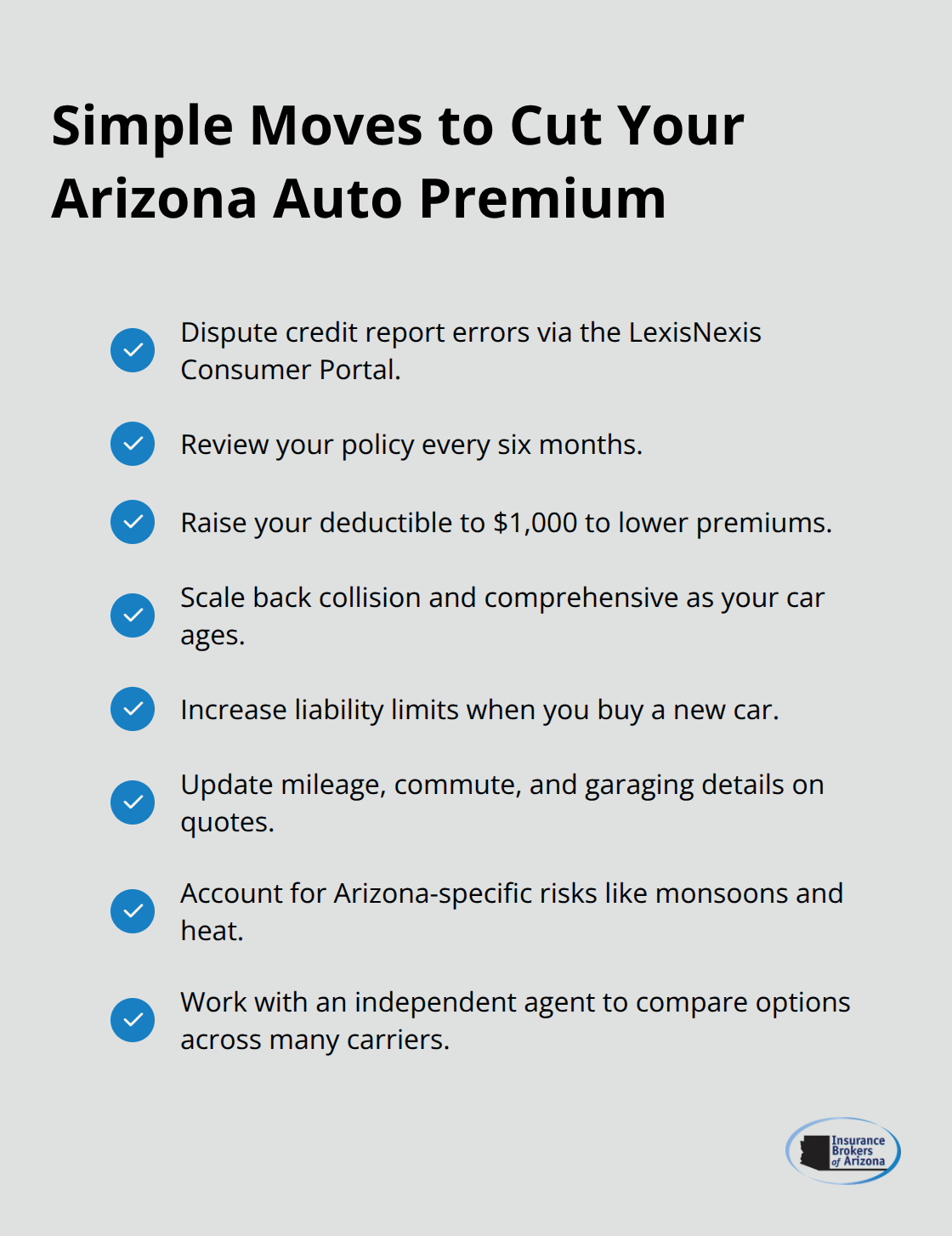
Family auto insurance costs add up fast. Between multiple drivers, vehicle coverage, and monthly premiums, many households struggle to find affordable auto insurance for families without sacrificing protection.

We at Insurance Brokers of Arizona® know the frustration. That’s why we’ve put together practical strategies to lower your rates, compare quotes effectively, and keep your family covered without overspending.

What Actually Drives Your Auto Insurance Rates

Your driving record is the single biggest lever you control. A clean record costs money-lots of it. According to Bankrate data via Quadrant Information Services, a single at-fault accident raises your premiums by roughly 43%, and a DUI conviction pushes costs up about 96% compared with a clean record. Insurers won’t negotiate this. Even one mistake stays on your record for years, so defensive driving isn’t optional if you want affordable rates.

Percentage increases from at-fault accident and DUI versus a clean record

If you’ve had incidents, focus on staying claim-free moving forward. That good-driver discount kicks in after you prove you won’t file claims, and it stacks with other discounts.

How Your Vehicle Choices Impact What You Pay

The car itself matters more than most families realize. A Tesla Model 3 costs about $285 per month for full coverage, while a Toyota Prius runs $231 and a Ford F-150 costs $219, according to Bankrate’s 2025 analysis. The difference comes down to repair costs and parts availability. High-end vehicles, sports cars, and newer EVs all cost significantly more to insure because parts are expensive and specialized repair shops charge premium labor rates. An older sedan costs less to insure than a brand-new truck, period. For families with teen drivers, this matters even more. Choosing a used sedan instead of a new vehicle can meaningfully lower your teen’s premiums. Vehicle age also factors in-older cars cost less to insure, so purchasing a clunker for a teen driver makes financial sense.

Location and How Far You Drive Changes Everything

Where you live and how much you drive determine a massive portion of your rate. The cheapest states for full coverage in 2025 are Idaho, Vermont, Hawaii, Maine, and New Hampshire, where premiums run roughly 38% to 45% below the national average of $2,697 annually. Louisiana, New York, Florida, Nevada, and New Jersey are the most expensive, with premiums up to 53% above average. You can’t move to save money on insurance, but you can reduce your annual mileage. A low-mileage discount applies when you drive under roughly 7,500 miles per year. If you work from home or your commute is short, you qualify for this discount. Commute distance directly affects accident risk and claim frequency, so insurers reward shorter drives with lower rates.

What Comes Next: Taking Action on These Factors

Understanding what drives your rates is half the battle. The other half involves taking concrete steps to lower what you actually pay each month. Your driving record, vehicle choice, and location set the foundation, but your next move determines whether you’ll pay full price or unlock real savings through smart strategy choices.

How to Cut Your Family’s Auto Insurance Bill in Half

Stack Discounts by Bundling Policies

Bundling your home and auto policies with the same insurer cuts what you pay each month faster than any other single move. Homeowners who bundle with auto typically save about 10% on average across policies, according to The Zebra’s analysis. On a $2,697 annual full-coverage premium, a 10% bundling discount saves you roughly $270 per year. Some families see even larger reductions-Bankrate reports that bundling auto with homeowners or renters insurance can reduce premiums by up to 35% compared with holding separate policies from different carriers.

Typical and maximum savings from bundling home and auto policies - affordable auto insurance for families

One insurer covering multiple lines of business has lower acquisition costs and retention risk, so they pass savings to you. If you currently have home or renters coverage elsewhere, call your agent and ask for a bundling quote. You’ll almost always come out ahead.

Leverage Good Grades and Safe Driving Records

Safe driving and good grades unlock real money for families with teen drivers. A good student discount applies to teens maintaining a 3.0 GPA or higher and saves about $283 per year on average, according to data from The Zebra. For a 16-year-old whose annual premium averages $5,744, that $283 discount is meaningful. Defensive driving courses also reduce premiums when you complete an insurer-approved safe driving program, though the exact savings varies by company. More importantly, staying claim-free triggers a good-driver discount that compounds over time. A single claim can cost you dearly-a 43% premium increase for an at-fault accident-so avoiding claims matters far more than chasing small discounts.

Raise Your Deductible to Lower Monthly Costs

Increasing your deductible from $500 to $1,000 cuts costs by roughly 9%, and jumping to a $2,000 deductible saves about 16%, according to Bankrate’s 2025 analysis. For a 16-year-old, that $2,000 deductible could mean $919 in annual savings. The trade-off is straightforward: you pay more out of pocket if you file a claim, but you pay significantly less in monthly premiums.

Savings from moving to $1,000 and $2,000 auto insurance deductibles - affordable auto insurance for families

If your family has an emergency fund and can cover a $2,000 deductible without hardship, this move makes sense. Your deductible should match your ability to pay, not some arbitrary rule. The bundling discount you secured stacks with this deductible strategy, meaning your savings compound when you combine multiple approaches.

Combine Multiple Strategies for Maximum Savings

The real power emerges when you layer these tactics together. A family that bundles policies, qualifies for a good student discount, and raises their deductible from $500 to $2,000 captures savings across three separate levers simultaneously. Each discount stacks independently, so your total savings multiply rather than stay flat. The next step involves comparing what different insurers actually charge for your specific situation, since rates vary dramatically by carrier and location.

Comparing Quotes and Choosing the Right Coverage

Getting multiple quotes is non-negotiable if you want competitive rates, but most families approach this wrong. They request one or two quotes, see a number, and assume that’s the market price. Rates vary wildly by carrier and location. According to The Zebra’s analysis of over 83 million insurance rates nationwide, the same driver in the same ZIP code can see premiums that differ by hundreds of dollars depending on which insurer quotes them. GEICO, Nationwide, and Erie are often among the cheapest carriers on average, but individual results depend entirely on your specific situation-your driving history, vehicle, age, and claims background.

Request Quotes from Multiple Carriers

When you shop for insurance, collect quotes from at least three to five major carriers, not one or two. Most insurers offer free quotes online in under five minutes, so there’s no reason to skip this step. Compare the exact same coverage limits across all quotes so you’re actually comparing apples to apples. If one quote includes a $1,000 deductible and another uses $500, you’re not seeing the real price difference. Request the same liability limits, collision coverage, and comprehensive coverage from each carrier, then line up the monthly costs side by side. You’ll spot which insurers price your profile favorably and which ones don’t.

Understand What Each Coverage Type Protects

Full coverage means collision and comprehensive protection on top of liability, and it costs roughly $2,697 per year on average nationally according to Bankrate’s 2025 data, compared to minimum liability-only coverage at about $820 per year. If you finance or lease your vehicle, your lender requires full coverage, so you don’t have a choice. If you own your car outright, the decision hinges on your vehicle’s value and your financial cushion. An older car worth $3,000 doesn’t justify $200 monthly premiums for collision and comprehensive coverage. A newer vehicle worth $25,000 absolutely does.

The real mistake families make is keeping coverage they don’t need or dropping coverage they should keep. Collision pays for accidents you cause, comprehensive covers theft and weather damage, and liability covers damage you cause to others. Your deductible applies to collision and comprehensive only, not liability. When you raise your deductible to $2,000 as discussed earlier, that savings only applies to these two coverages.

Set Liability Limits That Match Your Assets

Liability limits should match your assets and risk exposure. If you own a home, carry at least $100,000 in bodily injury liability per person and $300,000 per accident, or you risk losing everything in a lawsuit. These limits protect your financial future when you cause serious injury or property damage to someone else. Most families underestimate their exposure and carry inadequate limits to save a few dollars monthly. That decision can cost you hundreds of thousands in a major accident.

Review Your Policy Annually for Missed Savings

Annual policy reviews catch coverage gaps and identify savings you’ve missed since last renewal. Your situation changes-your car ages, your driving record improves, or you move to a safer neighborhood. These changes can lower your rates, but your insurer won’t automatically adjust your premium downward. You must request new quotes and compare them to what you currently pay. Many families stay with the same carrier for years without realizing they could save $50 to $100 monthly by switching or negotiating a better rate.

Final Thoughts

Finding affordable auto insurance for families requires action, not just reading. You now understand what drives your rates, how to stack discounts, and why comparing quotes matters. The strategies in this guide work because they address the real factors insurers use to price your coverage, and a clean driving record, smart vehicle choices, bundling policies, and raising your deductible create compounding savings that add up to hundreds of dollars annually.

Don’t settle for one or two quotes when you shop for coverage. Request quotes from at least three to five carriers using identical coverage limits, then compare the actual monthly costs side by side. Your situation is unique, and rates vary dramatically by insurer and location-a carrier that charges $150 monthly for one family might quote $220 for another in the same ZIP code.

We at Insurance Brokers of Arizona® work with over 40 reputable carriers, which means we can access competitive options you might not find on your own. Contact Insurance Brokers of Arizona® to start comparing quotes today, and our agents will walk you through coverage options, explain what each type protects, and show you exactly where you can cut costs without sacrificing protection for your family.

Disclaimer: The information provided in this blog is for general informational purposes only and does not constitute legal, financial, or insurance advice. Coverage options, terms, and availability may vary. Please consult with a licensed professional for advice specific to your situation.
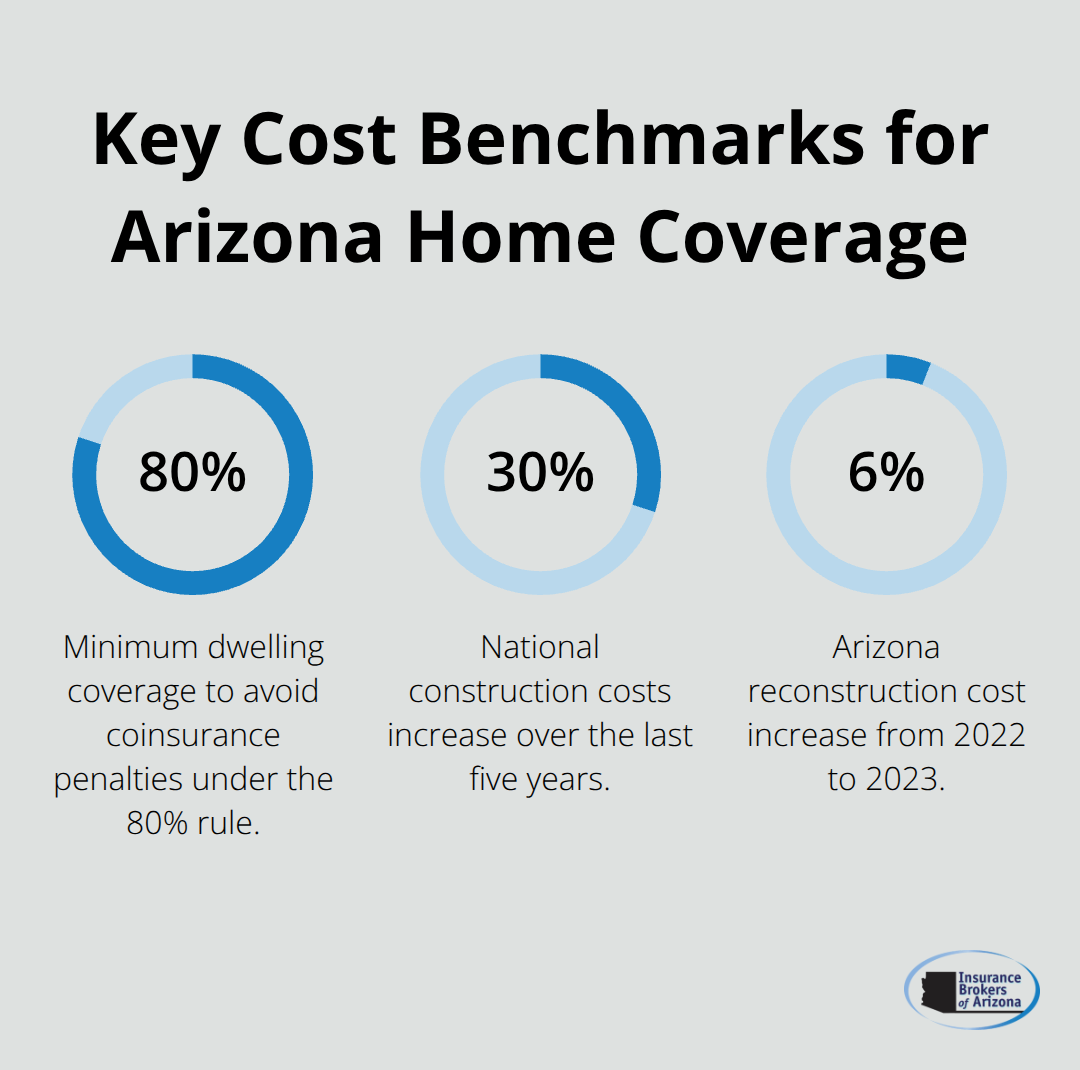
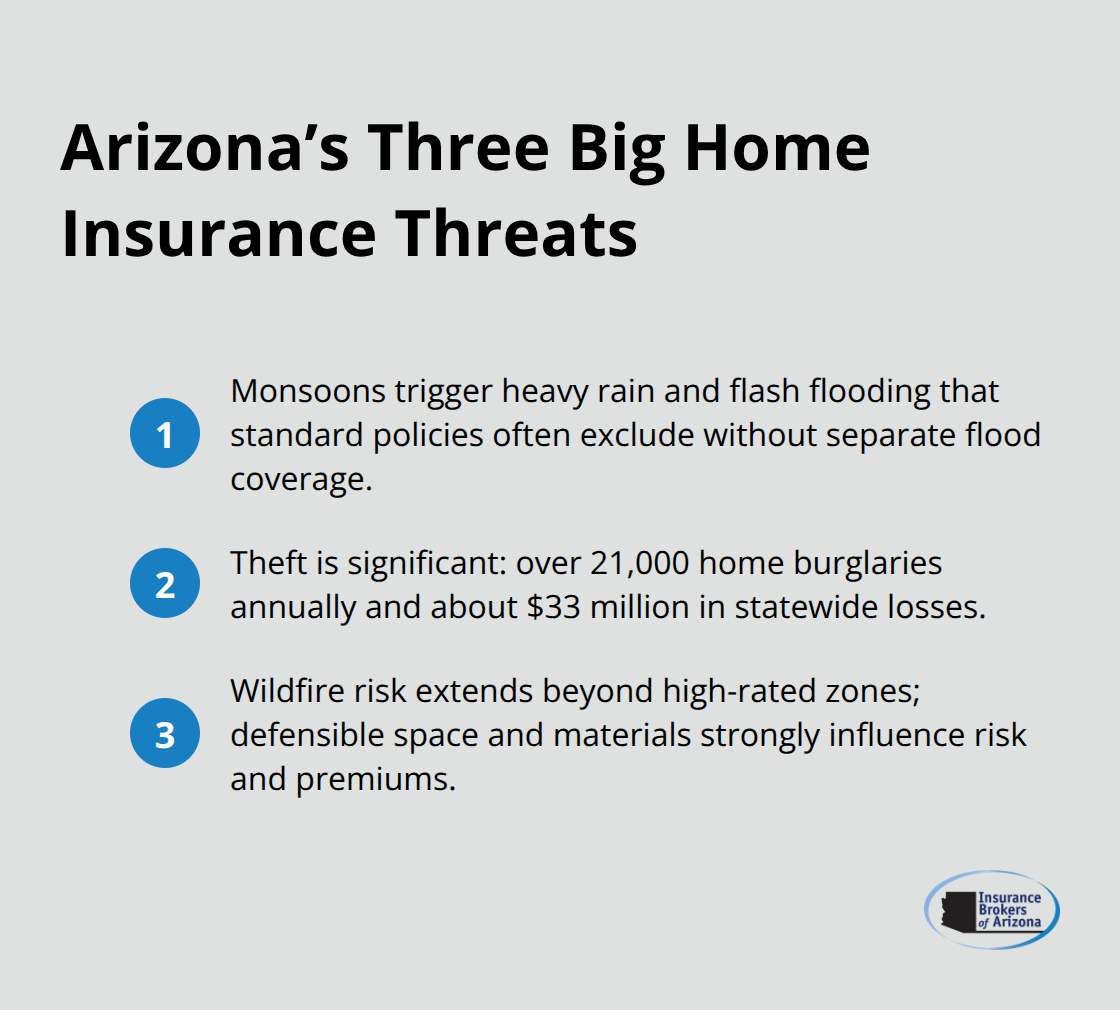
Auto liability insurance covers the costs when you’re found responsible for injuring someone or damaging their property in a car accident. Yet many drivers misunderstand what this coverage actually protects-and what it doesn’t.

Here at Insurance Brokers of Arizona®, we’ve seen firsthand how confusion about liability limits leads to serious financial exposure. This guide breaks down exactly how auto liability insurance works, what your state requires, and how to avoid costly coverage gaps.

What Auto Liability Insurance Covers

Auto liability insurance splits into two distinct parts that work together to cover costs when you cause an accident. Bodily injury liability pays for medical expenses, lost wages, pain and suffering, and legal fees when someone gets hurt because of your at-fault accident. Property damage liability covers repairs to the other driver’s vehicle, damage to buildings, fences, or other property destroyed in the collision. Liability never pays for your own injuries or vehicle damage-only for what you owe to the other party. Every state requires both components, though the minimum amounts vary significantly. Florida drivers must carry at least $10,000 in bodily injury per person coverage, while California requires only $15,000. Louisiana and New York sit at $15,000 and $25,000 respectively. Your state’s minimum represents the legal floor, not a recommendation for adequate protection.

Understanding Liability Limits in Practice

Most policies show liability limits as three numbers, such as 25/50/10, which means $25,000 per person for bodily injury, $50,000 total per accident for bodily injury, and $10,000 for property damage. According to ISO data from 2024, the average bodily injury claim costs $28,278-already exceeding many state minimums and standard limits. This matters because once your policy limit exhausts, you personally owe the remaining balance.

Quick guide to 25/50/10 limits and why higher limits matter - auto liability insurance covers

If someone accumulates $75,000 in medical bills and your policy covers only $50,000, you’re liable for the $25,000 difference from your own assets. Higher limits cost more upfront but protect your paycheck and savings when serious injuries occur. Financial experts recommend liability limits of at least $100,000 per person and $300,000 per accident to protect against these scenarios.

How Limits Interact With Real Accident Costs

State minimums exist primarily to meet legal requirements, not to protect your assets. A practical guideline suggests selecting limits that match or exceed your net worth, ensuring your house, savings, and retirement accounts stay protected if someone sues. If your net worth is $300,000, carrying only $25,000 in bodily injury coverage leaves you exposed to massive personal liability. The 2024 average collision payment reached approximately $10,000 per claim according to Highway Loss Data Institute data, and serious multi-person accidents routinely exceed $100,000 in total costs. An umbrella policy extends protection beyond your auto liability limits for roughly $150 to $300 annually per million dollars of coverage, offering affordable additional security.

Why Adequate Coverage Protects Your Financial Future

Underinsured drivers face devastating consequences when accidents exceed their policy limits. A single serious injury claim can wipe out years of savings and trigger wage garnishment or asset seizure. Your liability coverage directly determines how much financial exposure you carry personally. The difference between state minimums and adequate limits often amounts to just a few dollars per month in premium increases. Discussing your specific financial situation with a licensed agent helps you select limits that actually protect what you’ve built, rather than defaulting to state minimums that leave gaps. This conversation becomes even more important as you consider what happens when your coverage limits prove insufficient for the actual damages involved.

How Your Liability Coverage Works After an Accident

The moment you cause an accident, your liability coverage activates and follows a specific sequence. You report the incident to your insurer within the timeframe specified in your policy, typically within days of the accident. Your insurer then contacts the other driver’s insurer to begin the investigation and liability determination process. According to ISO data from 2024, property damage liability claims occur at a frequency of 2.50 per 100 earned car years, while bodily injury claims occur at 0.80 per 100 earned car years-meaning property damage claims are significantly more common. The other insurer gathers evidence, accident reports, witness statements, and medical records to establish fault. In most states, your insurer negotiates directly with the other party’s insurer to settle the claim within your policy limits.

Hub-and-spoke view of post-accident liability claim steps and facts - auto liability insurance covers

This process typically takes weeks to months depending on claim complexity and injury severity. Once liability is determined and damages are quantified, your insurer pays the settlement up to your chosen limits. If damages exceed your limits, you become personally responsible for the overage. Your deductible only applies to your own vehicle damage under collision or comprehensive coverage, not to liability claims you owe others.

How Coverage Limits Function as a Hard Ceiling

Your policy limits establish a hard ceiling on what your insurer pays. If you carry 25/50/10 limits and someone racks up $75,000 in medical expenses, your policy pays only $25,000 per person, leaving you liable for the remaining $50,000. The average bodily injury claim reached $28,278 in 2024 according to ISO, and serious accidents routinely exceed $100,000 in total damages when multiple people are injured. Higher limits cost more monthly but eliminate this personal liability exposure. Selecting limits that match your net worth is the only strategy that actually protects your assets, because courts can garnish wages and seize property to satisfy judgments exceeding your policy limits.

The Real Cost of Underinsurance

An umbrella policy extends protection beyond your auto liability limits for roughly $150 to $300 annually per million dollars of additional coverage, making it an affordable safeguard for anyone with substantial assets. Claims processing itself moves faster when liability is clear-cut, averaging 30 to 60 days for straightforward property damage claims. However, complex injury cases involving multiple parties or permanent disabilities can stretch to 6 to 12 months or longer. The gap between what your liability coverage pays and what damages actually total determines your personal financial exposure. Understanding this gap matters far more than simply meeting your state’s minimum requirements.

What Your Liability Coverage Actually Won’t Pay For

Most drivers believe their liability insurance protects their own vehicle when an accident happens. This misconception costs people thousands in unexpected out-of-pocket expenses every year. Your liability coverage exists solely to pay for injuries and property damage you cause to others, not to repair your own car or cover your medical bills.

Checklist of costs liability won’t pay and the coverages you need

If you hit another vehicle and your car sustains $8,000 in damage, your liability coverage pays nothing toward those repairs. You need collision coverage to handle your own vehicle damage, which is a completely separate policy component. This distinction matters enormously because many drivers discover this gap only after an accident occurs, when it’s far too late to add coverage. According to ISO data from 2024, collision claims average $5,489 per incident, and comprehensive claims average $2,306. Without these coverages, you absorb the full cost of fixing your vehicle from your personal funds.

Why State Minimums Leave You Dangerously Exposed

Many drivers assume that meeting their state’s minimum liability requirement provides adequate protection. This assumption is financially reckless. State minimums exist to meet legal requirements, not to protect your assets or match actual accident costs. In 2024, the average bodily injury claim reached $28,278 according to ISO data, yet numerous states allow minimum coverage of just $15,000 to $25,000 per person. This creates an immediate shortfall where your insurance pays only partial costs and you cover the remainder. Louisiana and Florida drivers face some of the nation’s highest insurance costs, with average annual premiums reaching $1,558 and $1,625 respectively according to NAIC data, yet many still carry minimum limits that leave them financially vulnerable. The real problem is that state minimums reflect political compromise, not financial reality. A single serious injury accident involving multiple people can easily exceed $100,000 in medical expenses, lost wages, and pain and suffering damages. Financial experts recommend liability limits of at least $100,000 per person and $300,000 per accident to protect against these scenarios. Carrying only $25,000 in bodily injury coverage means you personally owe $75,000 or more after your insurance limit exhausts. The monthly premium difference between minimum and adequate coverage typically amounts to $15 to $40, making the upgrade inexpensive compared to the protection it provides.

How Judgment Creditors Access Your Assets

Drivers often believe their personal assets remain protected as long as they carry some liability insurance. Courts and creditors view this differently. If a judgment against you exceeds your policy limits, creditors can garnish your wages, seize your bank accounts, and place liens against your home to satisfy the debt. A single serious accident can generate judgments of $250,000, $500,000, or higher when permanent disability or death occurs. Your $25,000 policy limit covers only a fraction of this exposure, leaving you personally responsible for the remaining balance. Financial experts recommend selecting liability limits that match or exceed your total net worth, which creates a genuine protective barrier. If your net worth is $400,000, carrying $100,000 in bodily injury coverage leaves $300,000 of your assets exposed to judgment creditors.

Why Umbrella Policies Fill the Critical Gap

An umbrella policy extends protection beyond your auto liability limits and covers the gap where your standard policy ends. These policies cost remarkably little-typically $150 to $300 annually per million dollars of additional coverage. Without this additional layer, your house, retirement accounts, and future earnings remain at risk from a single catastrophic accident. An umbrella policy activates only after your auto liability limits exhaust, so it works in tandem with your underlying coverage to provide comprehensive protection. For drivers with substantial assets (homes, savings, investment accounts), an umbrella policy represents one of the most cost-effective insurance decisions available. The protection it offers far exceeds what you pay in premiums, especially when you consider the alternative: losing everything to a judgment creditor.

Final Thoughts

Auto liability insurance covers the costs when you cause an accident, but only for injuries and property damage to others. This distinction separates drivers who understand their coverage from those who face devastating financial surprises after an accident. The gap between state minimums and adequate protection determines whether an accident depletes your savings or leaves your assets intact.

Carrying only your state’s minimum liability limits exposes you to serious financial risk. A single serious accident generates medical bills, lost wages, and pain and suffering damages that far exceed $25,000 or $50,000 limits, with the 2024 average bodily injury claim reaching $28,278 according to ISO data. When your policy limit exhausts, creditors garnish your wages, seize bank accounts, and place liens against your home to satisfy the judgment. Financial experts recommend liability limits matching or exceeding your net worth because this strategy actually protects what you’ve built.

We at Insurance Brokers of Arizona® work with over 40 reputable carriers to find competitive options tailored to your specific financial situation and risk tolerance. A licensed agent reviews your assets, discusses potential accident scenarios, and recommends limits that actually protect your future-often for just a few dollars monthly more than minimum coverage. Contact us today to discuss your liability coverage and ensure your protection matches your financial reality.

Disclaimer: The information provided in this blog is for general informational purposes only and does not constitute legal, financial, or insurance advice. Coverage options, terms, and availability may vary. Please consult with a licensed professional for advice specific to your situation.
Auto insurance can feel overwhelming, especially when deductibles enter the conversation. At Insurance Brokers of Arizona®, we’ve helped countless drivers understand what a deductible in auto insurance actually means and how it affects their coverage and costs.

The right deductible can save you money, but the wrong choice creates real financial stress when accidents happen. This guide walks you through everything you need to know to make a decision that fits your situation.

How Deductibles Work in Your Auto Insurance Claim

What You Actually Pay When You File a Claim

A deductible is the amount you pay out of your own pocket when you file a claim before your insurance company covers the rest. If your windshield costs $1,200 to replace and you have a $300 comprehensive deductible, you pay $300 and your insurer covers $900. That $300 comes directly from your bank account before the insurer processes anything. This is not an annual fee or something that resets yearly-you pay it per claim, meaning if you file two claims in one year, you pay the deductible twice. The most common deductible choice among drivers is $500, according to data from WalletHub, which reflects a practical balance between manageable out-of-pocket costs and reasonable premiums. Typical deductible options range from $250 to $2,000, though some insurers offer lower or higher amounts depending on your state and policy type. Your deductible directly affects how much money leaves your wallet when accidents happen, so choosing an amount you can actually afford matters more than chasing the lowest premium.

Why Insurers Require Deductibles

Insurers use deductibles to discourage frivolous claims and share risk with policyholders. If you had zero deductible, you would file claims for minor $200 damages, which costs the insurer more in administrative expenses than the actual repair. The deductible makes you think twice before filing small claims. This risk-sharing approach also helps insurers price premiums more accurately-drivers who can absorb higher deductibles demonstrate financial stability and typically file fewer claims. Raising your deductible from $500 to $2,500 typically cuts your premium by about 25%, making this one of the most effective ways to lower your monthly costs. This savings compounds over years: if you avoid filing claims, a higher deductible pays for itself through lower monthly costs.

Infographic showing that raising an auto insurance deductible from $500 to $2,500 can reduce premiums by about 25%. - what is deductible in auto insurance

However, the math works differently if you live in an area prone to hail, theft, or frequent accidents. Deductibles exist partly to manage insurer costs, which explains why they’re non-negotiable on most policies and why your choice directly influences your rate.

When and How You Pay Your Deductible

When you file a claim, the deductible payment happens after the claim is approved, not upfront. The insurer’s adjuster inspects the damage, approves coverage, and then subtracts your deductible from the payout. In some cases, the repair shop receives payment directly from the insurer minus your deductible, so you never handle the money. In other cases, you pay the shop first and the insurer reimburses you later, minus the deductible. If you’re not at fault in an accident, you might still pay your deductible initially, then recover it later when the other driver’s insurer reimburses you through a process called subrogation-but this can take months. Car and Driver notes that if you cannot pay the deductible, the insurer will still pay the damage estimate minus the deductible amount, but repairs may be delayed and your vehicle’s value could be affected. This timing reality makes building an emergency fund equal to your chosen deductible genuinely important, not just a suggestion.

Understanding how deductibles function in real claims helps you prepare financially and avoid surprises when accidents occur. The next section examines how to select a deductible that aligns with your personal finances and risk tolerance.

Picking a Deductible That Fits Your Budget

The Real Cost of Choosing Wrong

The gap between a $250 deductible and a $1,000 deductible is not just about numbers on paper-it’s about whether you can actually pay that amount when your car needs repairs. Drivers often prioritize the lowest monthly premium without considering whether they have $1,000 sitting in a bank account if an accident happens. Moving from a $500 to a higher deductible typically saves around $8 to $15 per month, but that savings only matters if you can absorb the extra $500 out-of-pocket cost when a claim occurs.

The math becomes critical here: if you save $100 per year by choosing a $1,000 deductible instead of $500, it takes five years of accident-free driving to break even on that higher deductible. If you live in an area with frequent hail storms or high theft rates, that break-even timeline stretches even longer because you’re more likely to file a claim within those five years. The practical reality is this-if you cannot comfortably write a check for your deductible amount within 24 hours, that deductible is too high.

Vehicle Value Changes Everything

Your vehicle’s age and value shift the deductible equation dramatically. A $2,000 deductible might make sense for a 2023 sedan worth $25,000, where the premium savings are substantial, but that same deductible on a 2010 Honda Civic worth $6,000 is financially reckless. If the car suffers $4,000 in damage, you’d pay $2,000 out of pocket to fix a vehicle that might not be worth repairing.

Financed or leased vehicles add another layer: your lender likely requires collision coverage and may mandate a maximum deductible of $500 or $1,000 regardless of what you prefer. Once you own the car outright, you gain flexibility, but until then, your deductible choice is partially constrained by loan terms.

Hub-and-spoke infographic showing key factors that influence choosing the right auto insurance deductible. - what is deductible in auto insurance

Building Your Financial Safety Net

The average driver experiences an accident roughly once every seven years according to insurance industry data, which means most drivers will face a deductible claim at some point during vehicle ownership. This seven-year window is your planning horizon-not whether you’ll have an accident, but when.

Building an emergency fund equal to your deductible is not optional financial advice; it’s a requirement for choosing any deductible above $250. If your current savings cannot cover your chosen deductible, lower it immediately and allocate the premium difference toward building that emergency fund. Your financial situation matters more than premium savings, and choosing a deductible you cannot afford creates genuine hardship when accidents happen.

The next section examines how your driving habits and claim history influence which deductible amount actually protects your wallet over time.

Common Deductible Mistakes That Drain Your Wallet

Selecting a Deductible You Cannot Afford

The most destructive deductible mistake happens long before an accident occurs: choosing an amount you cannot actually afford to pay. Drivers routinely select a $1,000 or $1,500 deductible to save $10 or $15 monthly on premiums, then panic when a claim arrives because they have no emergency savings. This creates a cascading problem-if you cannot pay the deductible within 24 hours, repairs get delayed, your vehicle sits unusable, and you may face additional expenses like rental car costs that exceed the premium savings you gained.

The insurer will still pay the claim minus your deductible, but you’ll be in financial distress waiting for reimbursement. Car and Driver reports that when drivers cannot pay their deductible, the repair shop may refuse to proceed, leaving you stranded. This is not a minor inconvenience; it’s a financial crisis triggered by selecting the wrong deductible.

The solution is straightforward: if you cannot write a check for your deductible amount right now from your savings account, that deductible is too high. Lower it to $500 or $250 and accept the slightly higher monthly premium. The premium difference between a $500 and $1,000 deductible is typically $8 to $15 per month according to industry data, which means you protect yourself from financial hardship for less than $200 per year.

Compact list infographic summarizing the most common auto insurance deductible mistakes to avoid.

Ignoring Changes in Your Financial Circumstances

The second critical mistake is assuming your financial situation remains constant throughout your policy year. Life changes rapidly: job loss, medical emergencies, reduced hours, or unexpected expenses can eliminate your emergency fund within weeks. Drivers who had comfortable savings when they chose a $1,000 deductible may face genuine hardship six months later if circumstances shift.

You must review your deductible annually and adjust it if your financial cushion shrinks. Your insurance policy is not locked in stone; you can contact your insurer to lower your deductible without penalty, and the rate adjustment applies immediately to your next billing cycle. Set a calendar reminder each year to assess whether your current deductible still matches your financial reality, your vehicle’s value, and your driving patterns.

The False Economy of Skipping Coverage

Avoid the temptation to skip collision or comprehensive coverage altogether to lower premiums. This creates a false economy because one accident costs far more than years of premium savings. A single uninsured claim can result in thousands of dollars in out-of-pocket expenses that dwarf any monthly savings you achieved. The real mistake is not reviewing your coverage annually as your life changes. This single habit prevents the financial devastation that follows when deductibles become unaffordable and leaves you exposed to catastrophic losses.

Final Thoughts

Your deductible choice determines how much financial stress you face when accidents happen, which is why this decision deserves serious attention rather than a quick glance at premium quotes. Understanding what a deductible in auto insurance means-recognizing that this single number affects both your monthly costs and your ability to recover from unexpected damage-helps you make decisions that protect your wallet over time. The most common deductible of $500 exists for a reason: it balances affordability with meaningful premium savings, though your personal situation may justify a different amount.

Select an amount you can actually pay from your savings account within 24 hours, because premium savings mean nothing if they force you into financial hardship when a claim arrives. Your vehicle’s value, your emergency fund, your driving patterns, and your lender’s requirements all influence which deductible truly protects you. A $1,000 deductible saves money only if you avoid filing claims for several years and have the cash reserves to cover it immediately.

Review your deductible annually as your life changes, since job transitions, medical expenses, or shifts in your financial cushion may require adjusting your coverage. Lowering a deductible takes minutes and applies immediately to your next billing cycle without penalties. Contact Insurance Brokers of Arizona® to review your current deductible and explore whether your coverage aligns with your actual financial situation and vehicle value.

Disclaimer: The information provided in this blog is for general informational purposes only and does not constitute legal, financial, or insurance advice. Coverage options, terms, and availability may vary. Please consult with a licensed professional for advice specific to your situation.