Arizona Commercial Property Insurance: Protecting Your Business Assets

Your Arizona business faces real risks every day. From equipment damage to theft, the threats to your assets are constant and costly.
Arizona commercial property insurance protects what you’ve built. We at Insurance Brokers of Arizona® help business owners understand their coverage options and find policies that match their actual needs.
What Your Arizona Business Property Insurance Actually Covers
Arizona commercial property insurance protects three core areas that directly impact your bottom line. First, it pays for repairs or rebuilds of your building structure itself-the roof, walls, foundation, and permanent fixtures. Second, it covers the equipment, inventory, furniture, and tools inside your building. Third, it reimburses you for lost income when a covered event forces you to temporarily shut down operations. This third component matters most to many Arizona business owners because a fire or break-in doesn’t just damage your assets; it stops your revenue cold. Arizona experiences over 2,000 wildfires annually according to the Arizona Department of Forestry and Fire Management, and monsoon storms regularly strike without warning.
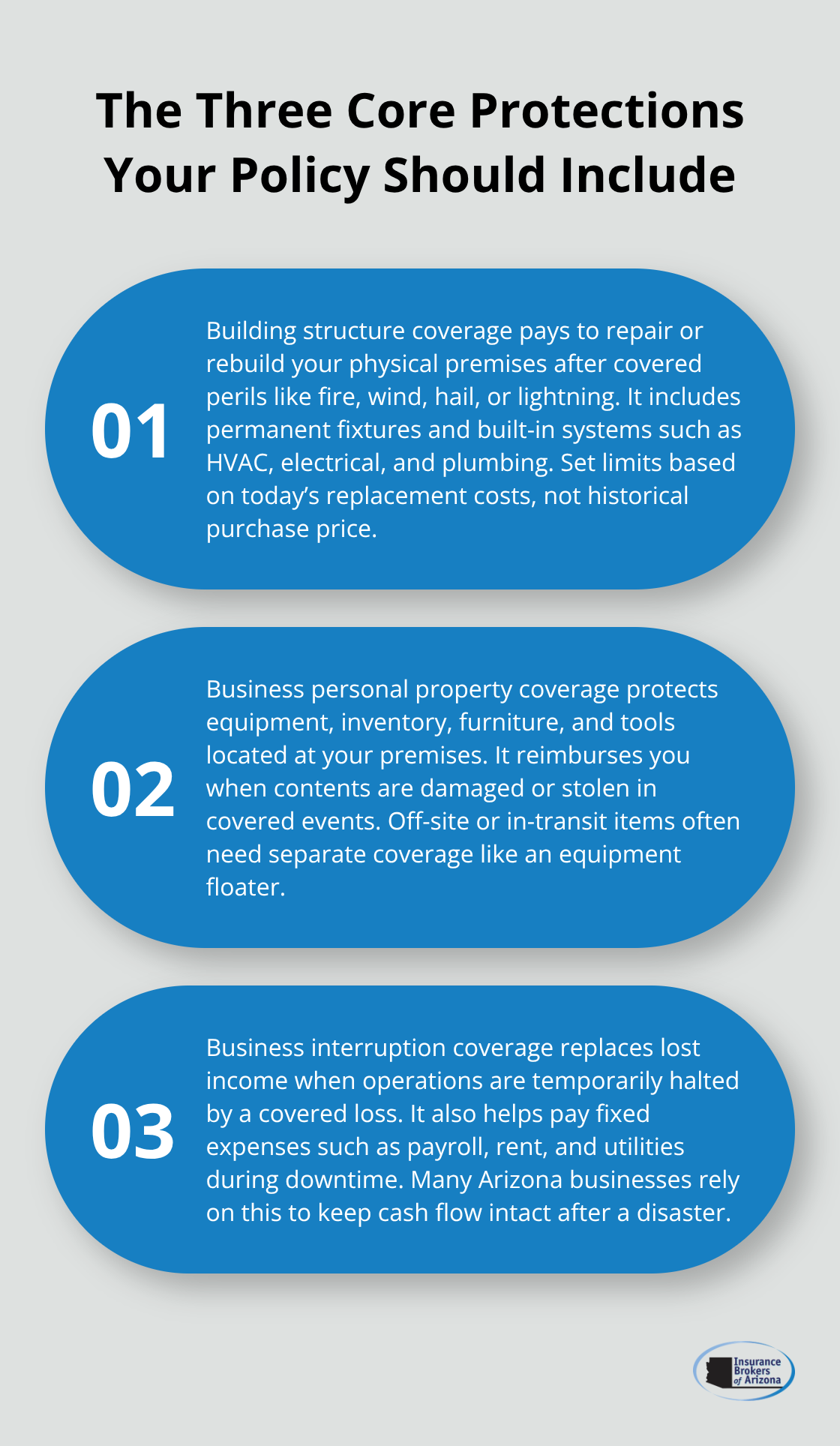
When these events hit, your building might survive intact but your operations still halt. Business interruption coverage fills that gap by covering payroll, rent, utilities, and other fixed costs while you rebuild or repair.
Building Structure Requires Real Replacement Costs
Your building’s coverage amount must reflect actual replacement cost, not what you paid for it years ago. If you own a 20-year-old commercial space in Phoenix worth $800,000 today, that’s the number that matters for your policy limit, not the $500,000 you bought it for. Obtain a third-party appraisal-don’t estimate. Construction costs in Arizona have risen substantially, and underinsurance leaves you personally liable for the gap. Coverage should include not just the structure but also built-in equipment like HVAC systems, electrical panels, and plumbing. Arizona’s extreme heat accelerates wear on air conditioning systems; make sure replacement costs for these systems factor into your building coverage. Many policies limit coverage for flood damage, which matters because Arizona’s monsoon season brings flash flooding to vulnerable areas. Verify whether your policy excludes flood damage entirely, then decide if you need separate flood insurance through the National Flood Insurance Program or a private carrier.
Equipment and Inventory Require Off-Site Protection
Business personal property coverage protects your equipment, inventory, and tools at your main location, but it typically has strict limits for items stored off-site or in transit. If your team works from client locations, job sites, or multiple branches, standard coverage leaves you exposed. Contractors, landscapers, and service professionals face this problem constantly. An inland marine policy or equipment floater extends protection to equipment and materials while they’re transported or stored temporarily away from your main property. This costs more than standard coverage, but losing $15,000 in tools on a job site costs far more. Arizona’s construction industry operates year-round, making off-site coverage essential for any contractor or installer. Document all equipment and inventory with photos and serial numbers; this accelerates claims processing when something goes wrong.
Business Interruption Covers More Than Lost Profits
Business interruption coverage should include not just lost profits but also fixed expenses-payroll, insurance premiums, rent, and loan payments continue whether your doors are open or closed. Without this coverage, a three-week closure from a kitchen fire at your restaurant or a break-in at your retail location drains your cash reserves faster than you can recover. Your policy should specify which expenses qualify for reimbursement and for how long coverage extends. Most policies cover 12 months of lost income, though some businesses need extended periods depending on their recovery timeline. The Arizona Department of Forestry and Fire Management data on wildfire frequency means many business owners in high-risk areas should treat this coverage as a core protection, not an optional add-on.
Understanding what your policy covers sets the foundation for choosing the right protection. The next step involves assessing your specific assets and determining which coverage types align with your actual business operations and location-based risks.
Why Arizona Businesses Must Protect Their Assets Now
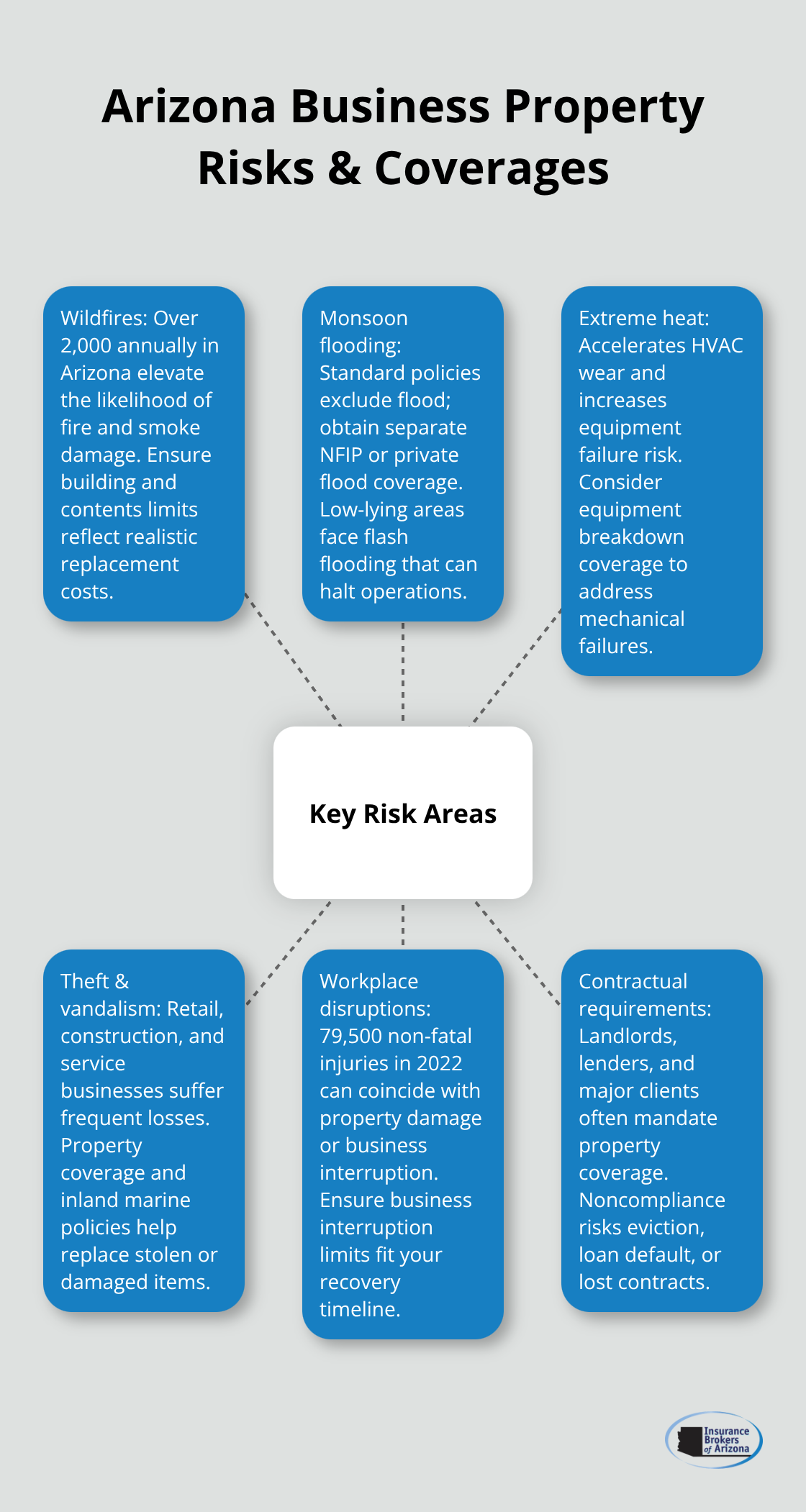
Arizona’s business environment exposes your company to threats that standard liability coverage simply doesn’t address. The state experiences over 2,000 wildfires annually according to the Arizona Department of Forestry and Fire Management, monsoon storms that arrive with little warning, and extreme heat that accelerates equipment failure. Commercial property insurance directly protects against these environmental hazards while also shielding you from financial devastation caused by theft, vandalism, and criminal activity. Without this coverage, a single fire, flood, or break-in forces you to absorb the full cost of repairs, replacement equipment, lost inventory, and halted operations from your own cash reserves. Arizona workplace injury data from the Bureau of Labor Statistics shows 79,500 non-fatal injuries occurred in 2022, many involving property damage or business interruption. Your policy also satisfies contractual requirements that clients, landlords, and lenders impose. Most commercial leases require tenants to carry property insurance, and many customers won’t work with uninsured vendors. Skipping this coverage creates legal and financial exposure that grows with every passing day.
Natural Disasters Strike Without Negotiation
Arizona’s wildfire season extends from spring through fall, with some years seeing unprecedented acreage burned. Monsoon storms create flash flooding in low-lying areas and can damage roofs, HVAC systems, and inventory in minutes. Extreme heat causes HVAC equipment to fail prematurely, and power surges from electrical storms damage computers and sensitive machinery. Standard commercial property insurance covers fire, wind, hail, and lightning damage to buildings and contents. However, flood damage requires a separate policy through the National Flood Insurance Program or private insurers because standard policies explicitly exclude it. If your business operates in a flood-prone area, this gap can be catastrophic.
Earthquake coverage also requires a separate endorsement in Arizona, though seismic activity poses lower risk than in California. Map your property’s exposure to each hazard, then confirm your policy addresses them. A broker can help identify which additional endorsements make sense for your location and business type.
Theft and Vandalism Drain Cash Faster Than Most Owners Expect
Retail locations, construction sites, and service businesses lose tens of thousands annually to theft and vandalism. Commercial property coverage reimburses you for stolen inventory, damaged equipment, broken windows, and graffiti removal. This protection extends to theft by employees, which statutes require you to address through separate crime insurance if your standard policy has limits. A contractor leaving tools on a job site overnight faces significant theft risk; an inland marine policy covers this exposure. A retail store with merchandise displayed near windows faces vandalism risk; property insurance covers repairs and replacement. The coverage applies 24/7, whether your business is open or closed, staffed or vacant. Without it, you absorb 100 percent of the loss. Most Arizona businesses underestimate their exposure to these risks until they experience a break-in or discover equipment missing from a job site. The financial hit often forces difficult choices about payroll, inventory restocking, or equipment replacement that cash flow can’t support.
Legal and Contractual Requirements Are Non-Negotiable
Arizona doesn’t legally require commercial property insurance the way it mandates workers compensation. However, your landlord almost certainly requires it in your lease agreement. Your lender requires it if you financed your building or equipment. Major customers often require proof of coverage before signing contracts. Violating these contractual obligations can result in eviction, loan default, or loss of major accounts. Additionally, if someone is injured on your property and sues, your general liability insurance covers their medical costs and legal fees, but property damage claims fall to you personally without property coverage. This liability exposure extends to adjacent properties if your building catches fire and spreads to a neighbor’s structure. Property insurance protects not just your assets but your legal standing with landlords, lenders, and business partners. Skipping it creates unnecessary risk that extends far beyond your own balance sheet.
Coverage Gaps Leave You Exposed to Hidden Costs
Many Arizona business owners discover too late that their policies contain exclusions or limits they didn’t anticipate. Standard property policies often cap coverage for equipment stored off-site, leaving contractors and mobile service providers underprotected. Data from the Arizona Department of Forestry and Fire Management highlights wildfire risk, yet some policies limit coverage for smoke damage or ash contamination to inventory. Equipment breakdown coverage (sometimes called boiler and machinery insurance) protects against mechanical failure, but standard property policies exclude this entirely. Flood and earthquake endorsements cost extra but address real Arizona hazards. Crime coverage for employee theft operates separately from property coverage and requires its own policy limits. The practical step is to work with a broker who understands Arizona’s specific risks and can identify gaps in your current protection before a loss occurs.
Selecting the Right Policy for Your Arizona Business
List Every Asset and Calculate Real Replacement Costs
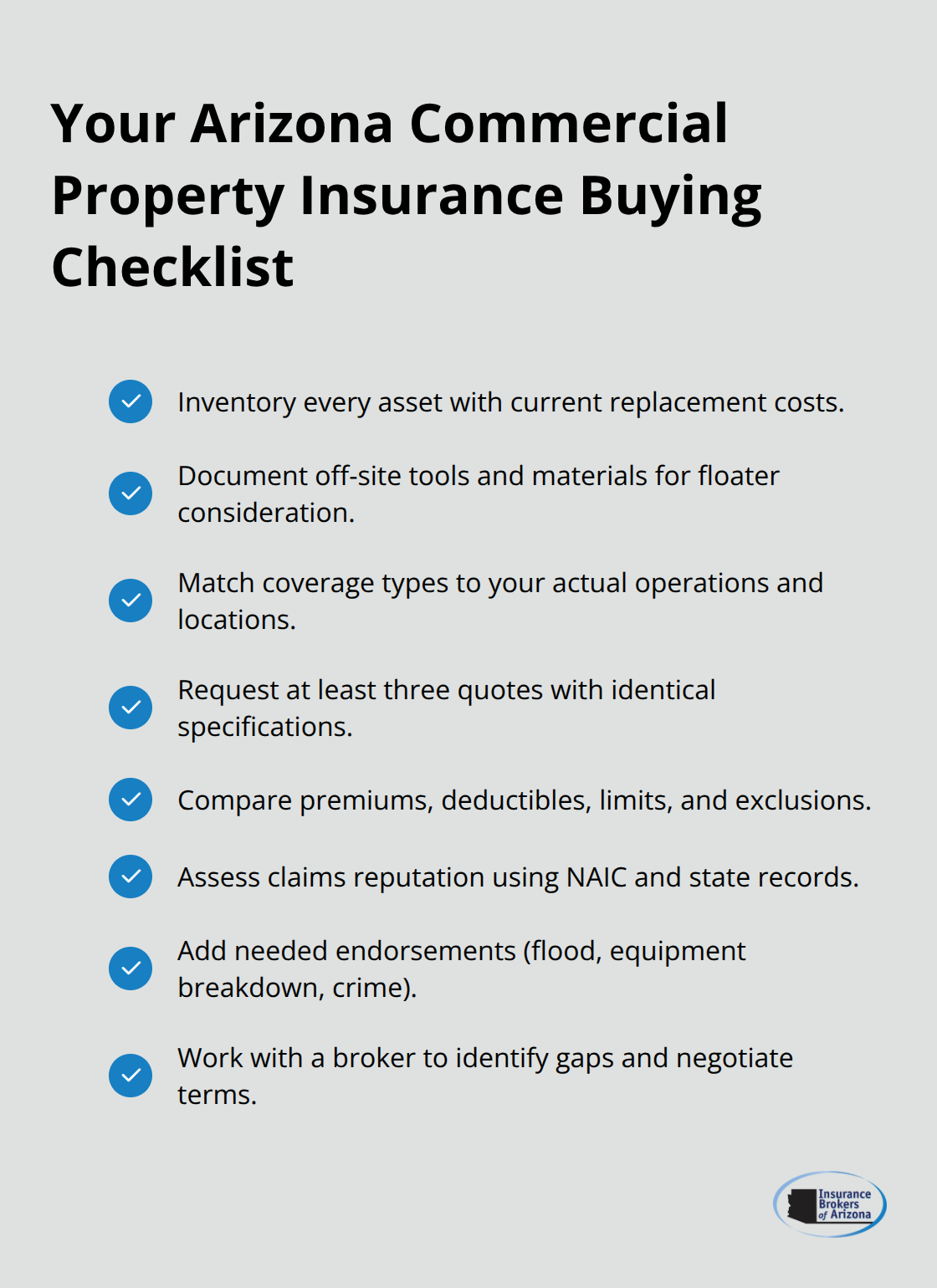
Start with a complete inventory of every asset your business owns or operates. Walk through your physical location and photograph equipment, inventory, furniture, and fixtures. For contractors and service businesses, document tools and materials at job sites and storage facilities. Note the replacement cost for each item, not the purchase price from years ago. Arizona construction costs have risen substantially, and using outdated values leads to dangerous underinsurance. For buildings, obtain a professional appraisal rather than estimating. This single step prevents the most common mistake we see: business owners discover after a loss that their coverage falls $50,000 to $200,000 short of actual replacement costs.
Match Coverage Types to Your Actual Operations
Once you have accurate asset values, determine which coverage types align with your operations. A restaurant owner needs business interruption coverage because a three-week kitchen closure destroys cash flow regardless of whether the building itself survives. A contractor needs inland marine coverage for off-site equipment because tools disappear constantly from job sites. A retail store needs crime coverage for employee theft because standard property policies exclude it. The coverage gaps that matter depend entirely on how your specific business operates and where your assets are located.
Arizona’s wildfire exposure means businesses in Flagstaff, Prescott, or northern Scottsdale should prioritize wildfire-related coverage and smoke damage endorsements. Monsoon-prone areas near Tucson or Phoenix need robust flood protection through separate policies since standard coverage explicitly excludes flood damage. Your location and industry determine which endorsements protect your bottom line most effectively.
Request Quotes from Multiple Carriers with Identical Specifications
Once you understand your actual needs, request quotes from multiple carriers. Don’t accept the first quote or assume your current homeowner’s insurer offers competitive commercial rates. Major carriers active in Arizona include State Farm, Farmers, Liberty Mutual, Nationwide, The Hartford, and Travelers, but rates and coverage options vary significantly between them. Obtain at least three quotes with identical coverage specifications so you can compare apples to apples.
Many carriers offer online quote tools, but Arizona commercial policies typically require a representative to contact you before binding coverage, so expect a follow-up phone call. When comparing quotes, examine not just the premium but also the deductible structure, coverage limits, and exclusions. A policy $200 cheaper monthly might exclude equipment breakdown or impose a $10,000 deductible instead of $2,500, making it far more expensive when you file a claim.
Evaluate Claims Reputation and Carrier Reliability
Review the claims process and reputation for each carrier. Check the National Association of Insurance Commissioners complaint database and Arizona Department of Insurance records to see how each insurer handles claims in your state. A broker relationship matters more than choosing the absolute lowest premium. A good broker identifies coverage gaps you might miss, negotiates better terms based on your risk profile, and advocates for fair claim settlements when losses occur.
Insurance Brokers of Arizona® partners with over 40 carriers, which means you access pricing and coverage options most business owners never see when shopping alone. We customize policies by understanding your specific operations, reviewing your lease requirements and lender mandates, and ensuring your coverage grows as your business evolves. Rather than accepting standard policy language, a broker requests endorsements for your particular risks, negotiates deductibles that balance premium costs with your cash flow capacity, and reviews your policy annually as your asset values and operations change. This ongoing partnership prevents the expensive discovery months after a loss that your coverage didn’t actually protect what you thought it did.
Final Thoughts
Arizona commercial property insurance protects your business from the specific threats your state presents. Wildfires, monsoons, extreme heat, theft, and equipment failure happen to Arizona businesses every year, and the three core protections address your actual exposure: building structure coverage prevents financial devastation from fire or storm damage, business personal property coverage reimburses you for equipment and inventory losses, and business interruption coverage keeps your cash flow intact when operations halt temporarily. Your lease, lender, and major customers likely require proof of coverage anyway, so the real question isn’t whether to buy Arizona commercial property insurance but whether to buy it correctly.
Inventory your assets with current replacement costs, identify which coverage types match your operations, and request quotes from multiple carriers using identical specifications. Don’t settle for the lowest premium if it means accepting coverage gaps or high deductibles that drain your reserves during a claim. Partnership with an insurance professional makes the difference because you access pricing and coverage options most business owners never find shopping alone.
We at Insurance Brokers of Arizona® work with over 40 carriers to identify gaps specific to your location and industry, negotiate deductibles that fit your cash flow, and review your coverage annually as your business grows. When a loss occurs, we advocate for fair claim settlements instead of leaving you to negotiate alone with the insurer. Contact Insurance Brokers of Arizona® to discuss your specific needs and secure comprehensive protection for what you’ve built.
Disclaimer: The information provided in this blog is for general informational purposes only and does not constitute legal, financial, or insurance advice. Coverage options, terms, and availability may vary. Please consult with a licensed professional for advice specific to your situation.


