
Auto Insurance Deductibles Arizona: How They Work

Your auto insurance deductible is one of the most misunderstood parts of your policy. Many Arizona drivers pick a number without understanding how it affects their monthly payments or what happens when they file a claim.
We at Insurance Brokers of Arizona® help clients navigate these decisions every day. This guide breaks down how auto insurance deductibles work in Arizona and shows you how to choose the right amount for your situation.
How Deductibles Shape Your Premium and Financial Reality
Understanding What a Deductible Actually Costs
A deductible is the amount you pay out of your own pocket when you file a claim, and your insurer covers the rest. If you have a $3,000 repair bill and a $500 deductible, you pay $500 and your insurer pays $2,500. Deductibles apply per claim, not annually, so you’ll pay the deductible every single time you file an approved claim. Arizona’s most common deductible is $500, according to Kelley Blue Book, and it strikes a reasonable balance between keeping premiums manageable and avoiding massive out-of-pocket hits after an accident.
The Premium Savings Trap
Higher deductibles directly lower your monthly premium, sometimes dramatically. The difference between a $250 deductible and a $1,000 deductible can slice 30 to 40 percent off your premium, depending on the carrier. However, this savings only makes financial sense if you actually avoid filing claims. If you file two or more claims in five years, a higher deductible can wipe out years of premium savings. Arizona average car insurance costs about $1,926 per year according to Experian data from July 2026, so the math matters.
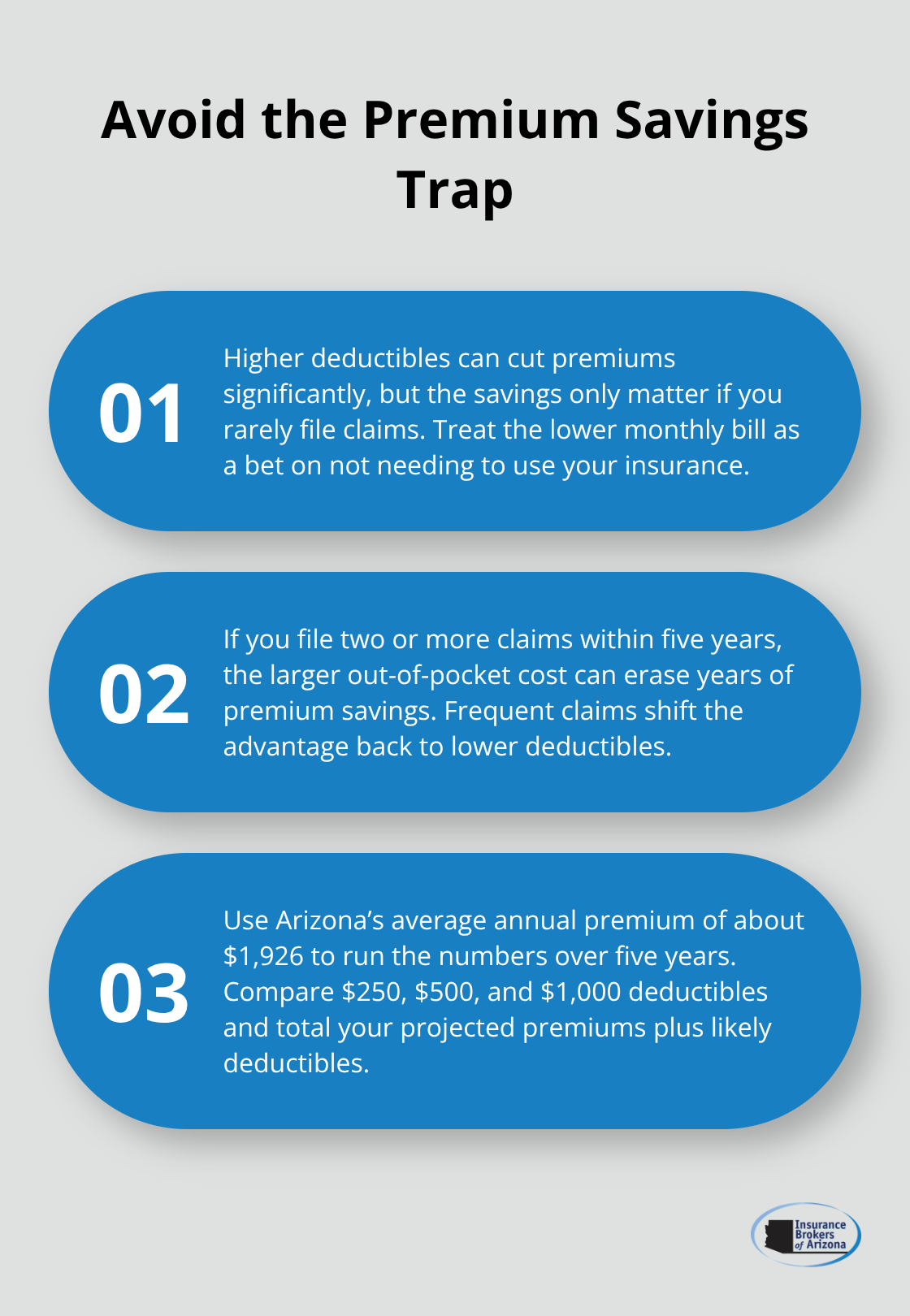
Get actual quotes from multiple carriers at different deductible levels-$250, $500, and $1,000-then calculate your total five-year cost across all options. Don’t chase the lowest monthly payment; look at what you’ll actually spend over time.
Your Emergency Fund Sets Your Deductible Ceiling
Your emergency fund determines how high you can safely go with your deductible. If you can’t access $1,000 within 24 hours, don’t pick a $1,000 deductible, because you could end up taking on debt to cover a claim. Most financial advisors recommend keeping three months of expenses in an emergency fund, and your deductible should sit comfortably within what you can pull from that cushion.
Vehicle Age and Repair Costs Matter
Vehicle age and value shift the equation significantly. If your car is paid off and worth under $5,000, dropping collision coverage entirely might be cheaper than paying a low deductible. Newer vehicles with expensive parts or electric vehicles often justify a lower deductible because repair costs run high. A mid-range $500 deductible typically delivers about 70 to 80 percent of the premium savings you’d get from a $250 deductible while still offering solid protection.
Optimize Across Coverage Types and Review Annually
You can optimize across coverage types by lowering your comprehensive deductible to $250 for theft or weather damage while keeping collision higher for premium savings. Some Arizona insurers waive the glass deductible if you use their repair shop, which is genuinely valuable for windshield damage. Review your deductible annually because major life changes-a new job, better savings, or reduced income-justify adjusting your choice. Once you’ve settled on a deductible that matches your finances and driving patterns, the next step is comparing what different carriers actually charge for that same coverage level.
Picking Your Deductible Based on What You Can Actually Afford
Start with a hard number: how much cash can you access within 24 hours without borrowing? That figure is your deductible ceiling, period. If your emergency fund holds $2,000, a $1,000 deductible forces you into debt after a single claim. Most people underestimate how quickly they must pay a deductible after an accident-insurance companies don’t wait for you to save up.
Arizona’s average annual car insurance cost sits at $1,926 according to Experian data from July 2026, which means your premiums already strain many household budgets. Adding a deductible you can’t cover turns a manageable claim into a financial crisis. The real calculation isn’t about the monthly premium savings-it’s about total five-year costs.
The Five-Year Math That Actually Matters
A driver paying $1,926 annually at a $250 deductible spends roughly $9,630 in premiums over five years plus $0 to $2,500 in deductibles if they file one or two claims. That same driver with a $1,000 deductible pays $5,757 to $6,897 in premiums over five years (30 to 40 percent less) but faces $1,000 to $2,000 in out-of-pocket deductibles per claim. File one claim, and the $1,000 deductible wins. File two claims, and the math flips entirely.

Get actual quotes from at least three carriers at $250, $500, and $1,000 deductibles, then add up what you’d actually spend across five years at each level. This approach beats chasing the lowest monthly payment every time.
Why $500 Works for Most Arizona Drivers
The $500 deductible isn’t the most common choice because it’s perfect-it’s common because it works for most people’s finances. Kelley Blue Book identifies $500 as Arizona’s most popular deductible for solid reasons. It cuts your premium roughly 15 to 20 percent compared to a $250 deductible while avoiding the aggressive risk of a $1,000 option.
A mid-range deductible delivers about 70 to 80 percent of the premium savings you’d get from jumping to $1,000 without forcing you into a corner if you need to file a claim. This balance makes $500 the practical choice for drivers who want meaningful savings without gambling with their finances.
Vehicle Type Changes Everything
Older cars worth under $5,000 and already paid off benefit from dropping collision entirely rather than paying any deductible. Newer vehicles, especially electric models with expensive repair costs, often justify staying at $250 for comprehensive and collision while keeping a higher deductible on liability (which doesn’t use a deductible anyway).
Arizona insurers sometimes offer zero-deductible glass coverage or waive the glass deductible if you use their repair shop, which matters because windshield damage claims are common in desert conditions. Optimize your coverage by lowering the comprehensive deductible to $250 for theft and weather while keeping collision at $500 or $1,000 for premium savings. This split approach gives you real protection where you need it without overpaying across the board.
Your vehicle’s repair costs and your financial cushion work together to determine the right deductible strategy. Once you understand how your specific situation shapes this choice, the next step involves comparing what different carriers actually charge for that same coverage level and finding the rates that fit your budget.
How to Lower Your Deductible Costs
Stack Discounts Across Your Policy
Most Arizona drivers leave money on the table because they treat their policy as static, never revisiting it or asking what discounts they qualify for. Experian data shows that bundling home and auto insurance, paying upfront instead of monthly, switching to paperless billing, and setting up autopay all reduce your premium, which directly reduces the financial burden of your deductible choice. If you drive fewer than 12,000 miles annually, you qualify for low-mileage discounts that some carriers offer, and a few insurers now provide pay-per-mile options that could save you significantly if your commute is short.
Defensive driving courses unlock discounts at most Arizona carriers, and improving your credit-based insurance score matters more than most people realize. Credit directly influences your rate at virtually every major insurer. These discounts compound when you stack them, so contact your carrier and ask which ones apply to your situation.
Build a Clean Driving Record
Your driving record is the single biggest lever you control. Arizona drivers with a clean record average roughly $1,786 per year, while one incident jumps that to $2,323, and three or more incidents push costs to $2,782 annually according to Experian data from July 2026. A single accident or violation can erase years of deductible savings through lower premiums, so safe driving is genuinely the cheapest insurance strategy available.
Compare Rates Across Multiple Carriers
Shopping around with multiple carriers is non-negotiable because premium variation in Arizona is extreme. Travelers averaged $1,772 annually for full coverage as of July 2026, while Mercury ran $1,964, Root $2,133, Liberty Mutual Direct $2,147, and GEICO $2,509-all according to Experian data.

That $737 gap between the cheapest and most expensive option means one carrier could offer a $500 deductible at a lower total cost than another carrier’s $1,000 deductible.
Contact at least three insurers and request quotes at $250, $500, and $1,000 deductibles; most carriers provide these comparisons instantly online or through an agent. Some Arizona insurers waive the deductible entirely for glass claims if you use their preferred repair network, which is a hidden savings opportunity for windshield damage-common in Arizona’s dust and hail seasons. Combining a mid-range $500 deductible with strategic discounts and competitive shopping often beats chasing lower deductibles at premium carriers.
Final Thoughts
Your auto insurance deductible in Arizona isn’t a set-it-and-forget-it decision-it’s a financial choice that shapes your monthly premium, your out-of-pocket risk, and your total costs over time. The right deductible balances what you can actually afford to pay after a claim against the premium savings that higher deductibles deliver. Most Arizona drivers find that a $500 deductible hits this balance well, cutting premiums roughly 15 to 20 percent while keeping financial risk manageable.
The biggest mistake is choosing based on monthly payment alone instead of calculating your five-year total cost at different deductible levels. If you file claims rarely and have a solid emergency fund, a higher deductible saves real money; if you file claims frequently or lack cash reserves, a lower deductible protects you from debt. Vehicle type matters too-older paid-off cars might not need collision coverage at all, while newer vehicles with expensive parts often justify staying at $250 for comprehensive and collision.
Shopping around with multiple carriers is essential because premium variation in Arizona is significant (one insurer might offer a $500 deductible at a lower total cost than another carrier’s $1,000 deductible). We at Insurance Brokers of Arizona® work with over 40 carriers to find coverage that matches your financial situation and driving needs. Contact us today to compare quotes at different deductible levels and discover the combination of deductible, coverage, and discounts that actually saves you money on auto insurance deductibles in Arizona.
Disclaimer: The information provided in this blog is for general informational purposes only and does not constitute legal, financial, or insurance advice. Coverage options, terms, and availability may vary. Please consult with a licensed professional for advice specific to your situation.


