
Arizona Homeowners Insurance: Why It Matters
Arizona homeowners face real threats that standard insurance often doesn’t address. Extreme heat, wildfires, and rapidly rising property values create gaps in coverage that leave many families underprotected.
At Insurance Brokers of Arizona®, we’ve seen firsthand how the right policy makes the difference between financial security and devastating loss. This guide walks you through what Arizona homeowners insurance actually covers and how to build protection that fits your home.
Why Arizona Homeowners Face Rising Insurance Costs
Wildfire Risk and Classification Impact
Arizona’s insurance landscape differs sharply from the rest of the country, and homeowners who don’t understand why often end up paying more than necessary or carrying inadequate coverage. Wildfire risk stands at the top of this problem. About 38 Arizona communities with graded fire departments are classified as 8B or worse on the ISO Public Protection Classification scale, which directly influences what insurers charge. This classification system ranks fire protection from 1 (best) to 10 (worst), and properties in higher-risk zones face substantially steeper premiums than those in safer areas.
Replacement Cost vs. Market Value
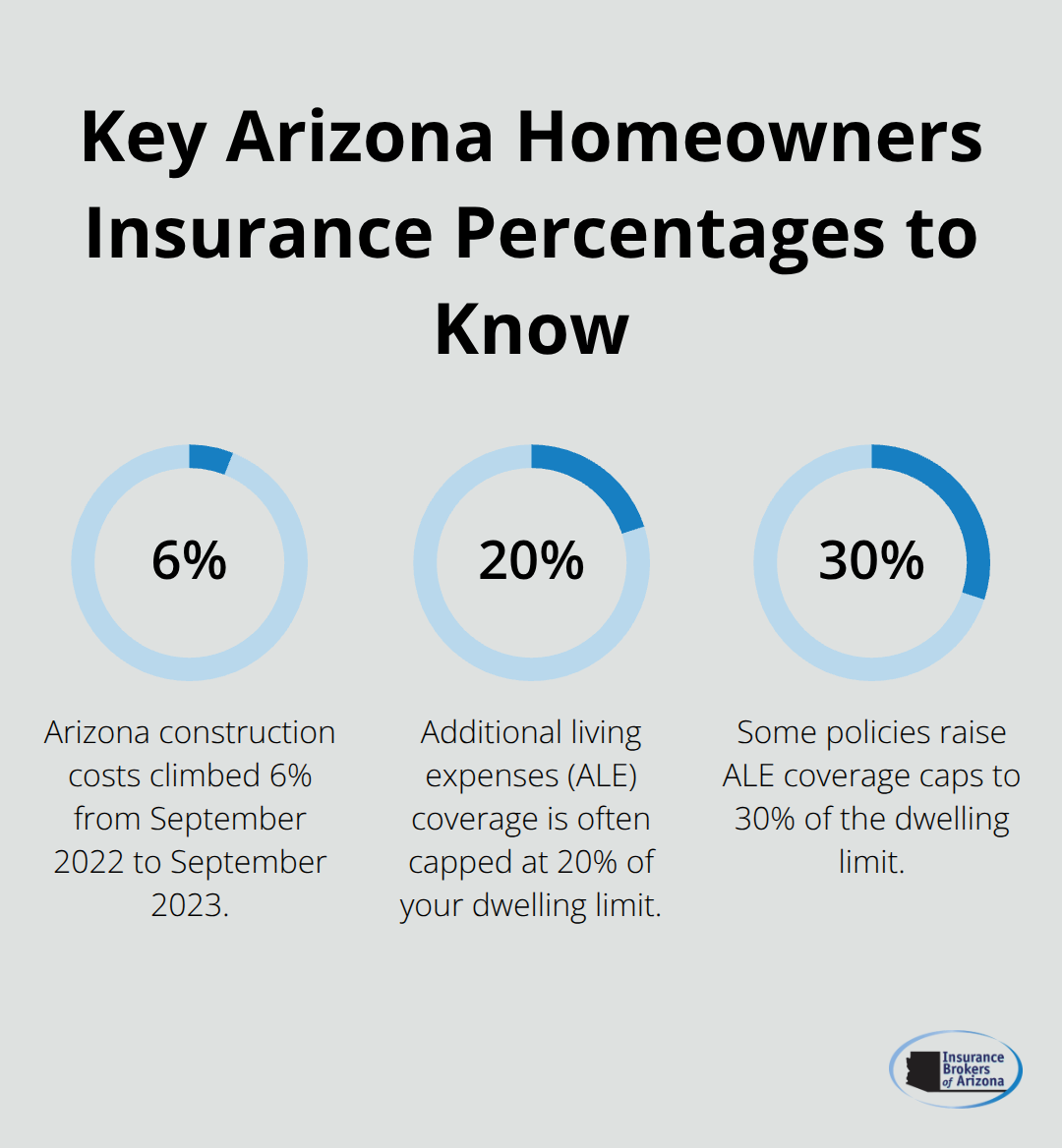
Construction costs across Arizona have climbed roughly 6 percent from September 2022 to September 2023 alone, which means your home’s replacement cost-not its market value-determines your actual coverage need. This distinction matters enormously. A home worth $400,000 on the market might cost $500,000 to rebuild with similar materials, especially after recent price increases. Underestimating replacement cost leaves you exposed to significant out-of-pocket losses if a covered event damages your home.
National and Regional Premium Trends
National data from NAIC shows homeowners insurance premiums rose between 18.3 and 43.3 percent since 2018, with Arizona tracking that upward trend. Company-initiated non-renewals have jumped roughly 96 to 216 percent depending on the region, meaning coverage availability itself has tightened considerably. These shifts reflect rising claim frequency and severity across the market, particularly from 2021 to 2024.
Arizona’s Cost Variation and Coverage Gaps
Arizona’s average annual homeowners insurance cost sits at $1,667 per year, according to Policygenius data from August 2026, which is near the national average but masks significant city-by-city variation. Phoenix residents pay around $1,781 annually, while Queen Creek residents pay closer to $1,451-a $330 difference for similar coverage in the same state. This variation reflects local wildfire exposure, construction costs, and claims patterns that your standard homeowners policy may not fully address. Standard HO-3 policies cover dwelling, attached structures, personal property, and liability, but they exclude flood damage entirely and often exclude earthquake damage unless you purchase separate coverage. Water intrusion from storms, fallen tree damage, and liability claims from injuries on your property are covered, but gaps emerge quickly when you consider Arizona-specific risks.
High-Risk Profiles and Premium Escalation
Homeowners with older properties or poor credit histories face even steeper premiums-USAA quotes in Arizona for a 50-year-old home run roughly $1,476 annually, while poor credit can push quotes to $14,868 with certain carriers. These numbers underscore why professional guidance matters more in Arizona than in many other states. Understanding your actual replacement costs and identifying coverage gaps before renewal notices arrive positions you to make informed decisions about your protection strategy.
What Your Arizona Homeowners Policy Actually Covers
The Four Core Areas of HO-3 Protection
Your standard HO-3 homeowners policy in Arizona covers four core areas: your dwelling structure, personal property inside and outside your home, liability protection if someone is injured on your property, and additional living expenses if you cannot stay in your home after a covered loss. The specifics matter far more than the category names, however. Understanding what each section actually pays determines whether you have real protection or dangerous gaps.
Dwelling Coverage and Reconstruction Reality
Your dwelling coverage pays to rebuild your home with similar materials if it sustains fire damage, windstorm, hail, or theft. Replacement cost-not market value-drives your coverage decision. If your home would cost $450,000 to rebuild today and you carry only $350,000 in dwelling coverage, you absorb $100,000 of reconstruction costs yourself. Arizona’s 6 percent construction cost increase from September 2022 to September 2023 means many homeowners who set coverage limits two years ago now face significant underinsurance. This gap widens every month as labor and material prices climb.
Personal Property and Liability Protection
Personal property coverage reimburses furniture, electronics, clothing, and other belongings after a covered loss, but standard policies pay actual cash value, which factors in depreciation. A five-year-old television worth $1,200 new might only receive $400 from your insurer under ACV coverage. Adding replacement cost coverage for personal property costs more in premium but eliminates depreciation calculations and pays what it actually costs to replace items today.
Liability protection covers injuries or property damage you cause to others, including legal defense costs and medical bills. If a guest falls on your icy driveway in winter and requires surgery, your liability coverage pays their medical expenses and any lawsuit that follows. Additional living expenses coverage pays for temporary housing, meals, and daily costs if a covered loss makes your home uninhabitable. This coverage typically spans 12 to 24 months of temporary housing costs, but only up to a percentage of your dwelling coverage-often 20 to 30 percent. A homeowner with $400,000 in dwelling coverage and 20 percent ALE coverage receives up to $80,000 for temporary living expenses.
Critical Coverage Exclusions in Arizona
Flood damage is completely excluded from standard homeowners policies in Arizona. If heavy rain causes water intrusion through your foundation or a nearby stream overflows, you pay all reconstruction costs yourself unless you purchased separate National Flood Insurance Program coverage. Earthquake damage is also excluded unless you add a specific earthquake rider. Arizona-specific risks like wildfire damage are covered under standard policies, but only if flames directly damage your home. If you lose your home to wildfire, your insurer pays up to your dwelling limit for reconstruction. Wind damage from monsoon storms or fallen trees receives the same treatment.
Identifying Your Coverage Gaps
The gaps emerge quickly when you consider what happens after the initial damage. Arizona homeowners facing rising replacement costs and increasing non-renewals must carry adequate dwelling coverage and understand their actual replacement cost. Without this foundation, you cannot build a protection strategy that matches your real exposure. The next step involves assessing your specific home’s replacement value and comparing how different carriers price that protection.
Building Your Coverage Strategy
Calculate Your Home’s True Reconstruction Cost
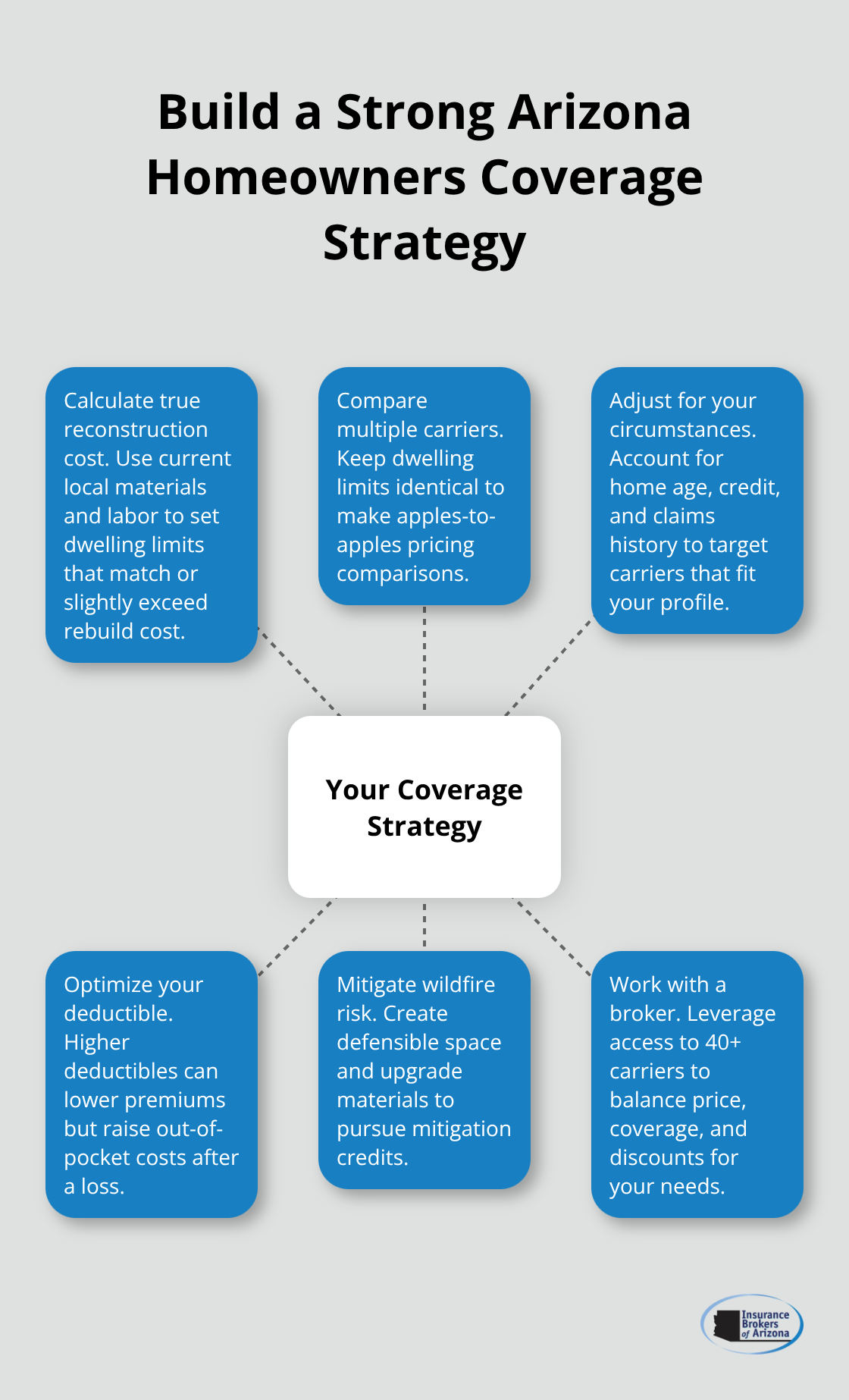
Start with your home’s actual reconstruction cost, not what you could sell it for today. Arizona’s construction expenses climbed 6 percent from September 2022 to September 2023, and that trajectory continues. Contact local contractors or use online replacement cost calculators to estimate what it would genuinely cost to rebuild your home with similar materials and finishes. A $400,000 market value means nothing if reconstruction costs $520,000. Once you have that number, set your dwelling coverage to match or slightly exceed it.
Underinsuring by even $50,000 creates a coinsurance penalty where your insurer pays proportionally less on claims. If you insure for $350,000 when replacement cost is $450,000, you’re only insured for 78 percent of the value, and your insurer will pay only 78 percent of covered losses. This penalty applies to every claim, making it one of the costliest mistakes Arizona homeowners make.
Compare Quotes Across Multiple Carriers
Shop quotes from at least three carriers using the exact same dwelling coverage amount so you can compare apples to apples. Arizona’s average annual homeowners cost is $1,667 according to Policygenius data from August 2026, but Phoenix residents average $1,781 while Queen Creek residents pay $1,451 for similar protection. That $330 difference reflects local wildfire risk and claims patterns, not policy quality.
Armed Forces Insurance averages $714 annually in Arizona while USAA runs $863, but these carriers often have eligibility restrictions like military service. State Farm averages $1,362 annually, roughly 22 percent below the state average. American Family quotes around $1,150 yearly with 11 available discounts. Farmers runs about $1,729 with extended replacement cost and declining deductibles up to 45 percent bundling savings on multiple policies.
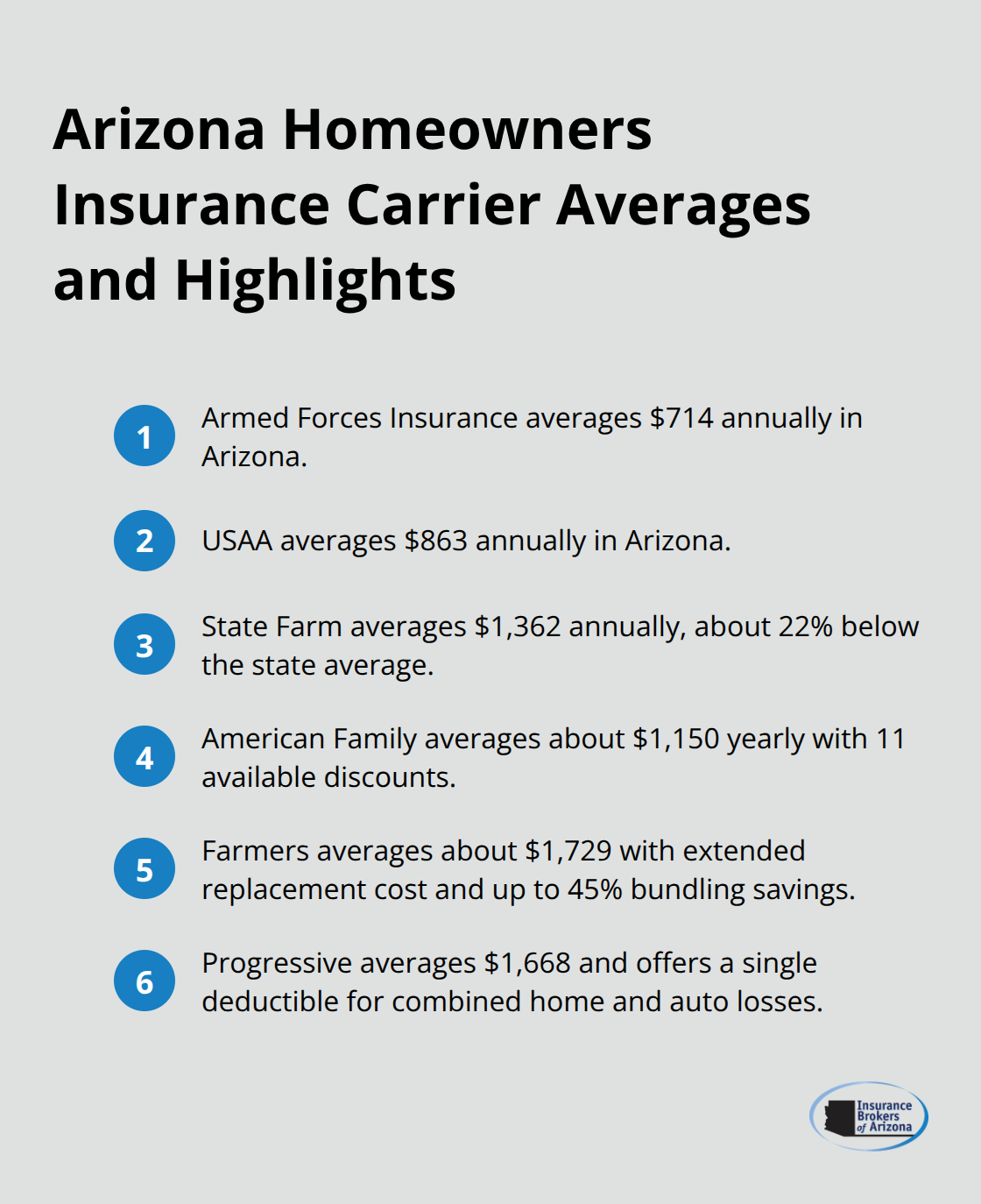
Progressive averages $1,668 and offers single deductibles if both home and auto are damaged in the same event.
Request quotes with your actual dwelling coverage amount, then compare what each carrier includes for personal property, liability limits, and additional living expenses coverage. Higher deductibles reduce premiums substantially but increase your out-of-pocket costs after a loss. A deductible typically saves 15 to 25 percent on annual premiums compared to a $500 deductible, but only if you can actually afford to pay that amount when a claim occurs.
Adjust Coverage for Your Specific Circumstances
Older homes and properties with poor credit histories face significantly steeper premiums across all carriers. USAA quotes for a 50-year-old Arizona home run roughly $1,476 annually compared to much lower rates for newer construction. Homes with three claims in five years see markedly higher quotes, with some carriers charging triple the standard rate.
If you have a claims history, focus on carriers that offer claim forgiveness programs or diminishing deductibles that reduce your out-of-pocket costs over time. If you rent out your home on platforms like Airbnb, Allstate offers HostAdvantage coverage up to $10,000 per rental period as an add-on. If wildfire risk affects your property, ask about mitigation credits for creating defensible space around your home or upgrading to fire-resistant materials. These actions can lower your premiums while genuinely reducing risk.
Work with a Broker to Find Your Best Match
Insurance Brokers of Arizona® partners with over 40 carriers to find options that match your specific profile, whether you face wildfire exposure, have an older home, or need specialized coverage for rental income. The goal is identifying which carrier offers the best combination of price, available discounts, and coverage options for your actual situation rather than accepting whatever quote arrives first.
Final Thoughts
Arizona homeowners insurance protects your financial security against risks that escalate every year. Rising construction costs, wildfire exposure, and tightening coverage availability mean the decisions you make today directly determine whether you’re protected or exposed when loss strikes. Your home’s market value and its reconstruction cost are two entirely different numbers, and Arizona’s 6 percent construction cost increase from September 2022 to September 2023 proves this gap widens constantly.
Shopping multiple carriers matters because Arizona homeowners insurance pricing varies substantially across the state. The difference between Phoenix’s $1,781 annual average and Queen Creek’s $1,451 reflects real differences in wildfire risk and claims patterns, but carrier pricing varies just as dramatically. Comparing quotes from State Farm, American Family, Farmers, and Progressive using identical dwelling coverage amounts reveals which carrier offers the best value for your specific situation, and your deductible choice can swing your annual cost by hundreds of dollars.
Professional guidance becomes essential when your home has older construction, a claims history, or sits in a high-risk wildfire zone. Contact Insurance Brokers of Arizona® to review your options and identify coverage gaps you might have missed. The cost of professional guidance is far lower than the cost of discovering your coverage was inadequate after a loss occurs.
Disclaimer: The information provided in this blog is for general informational purposes only and does not constitute legal, financial, or insurance advice. Coverage options, terms, and availability may vary. Please consult with a licensed professional for advice specific to your situation.


