
Personal Umbrella Coverage: How Much Do You Really Need?

Your homeowner’s and auto insurance policies have limits. Once you exceed those limits, you’re personally liable for the rest-and that can mean losing assets you’ve worked years to build.
Personal umbrella coverage fills that gap. At Insurance Brokers of Arizona®, we see clients every year who underestimate their exposure to catastrophic liability claims. The right umbrella policy protects your savings, investments, and future income when a single accident threatens everything.
What Personal Umbrella Coverage Actually Protects
Where Umbrella Coverage Kicks In
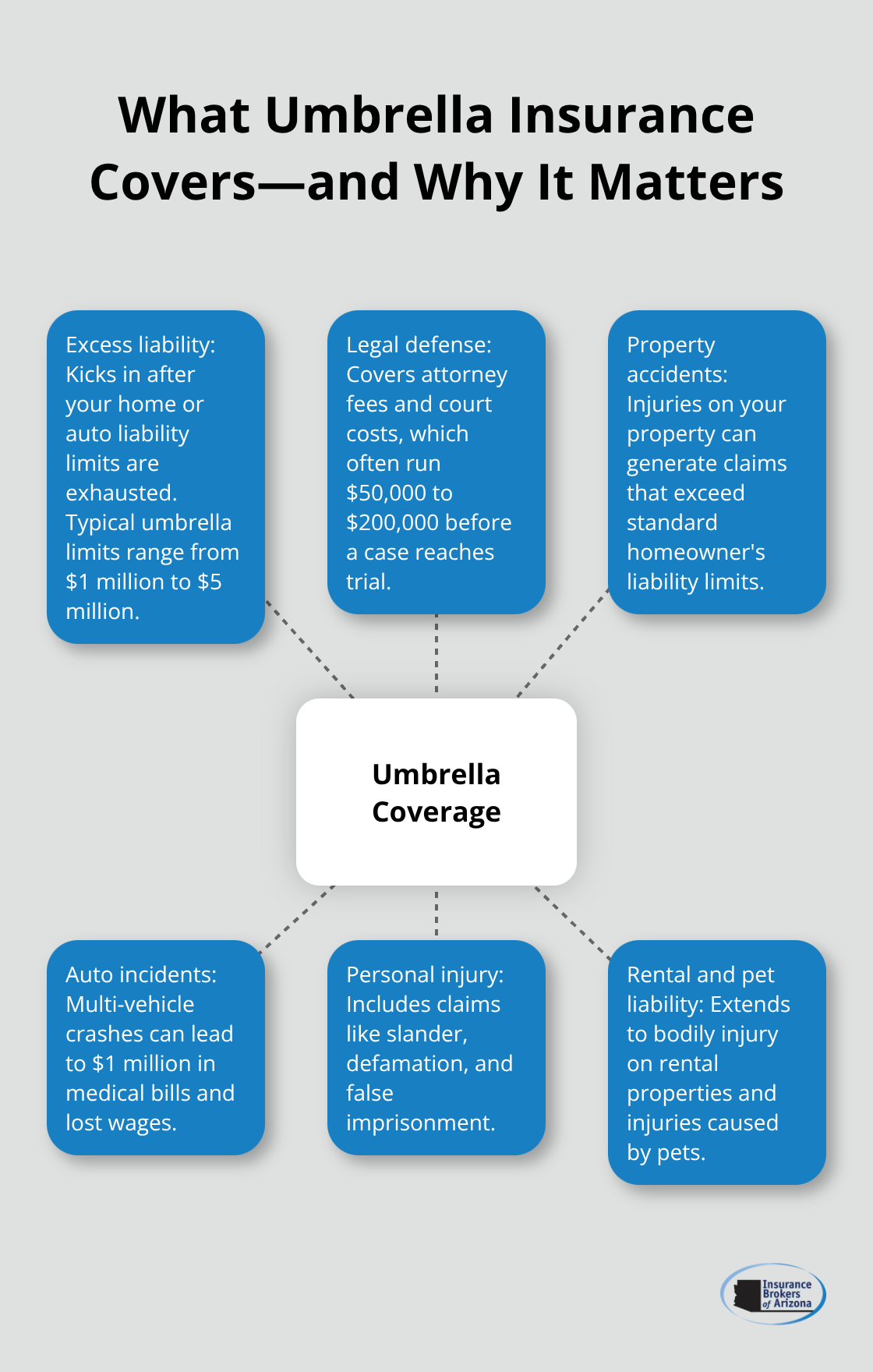
Your homeowner’s and auto insurance policies cap out at specific limits, typically $300,000 to $500,000 for liability. Once you exceed those limits, the insurance company stops paying and you start writing checks from your personal accounts. Umbrella coverage activates when your auto or home liability limits are exhausted, providing an extra layer of protection. A single car accident involving multiple vehicles can generate $1 million in medical bills and lost wages. A guest who slips on your property and requiring long-term care can sue for amounts that far exceed your homeowner’s liability limit. Umbrella policies typically start at $1 million and extend to $5 million or more, picking up where your auto and home insurance stops.
Types of Liability Claims Umbrella Policies Cover
The coverage applies to liability claims from accidents on your property, vehicle-related incidents, false imprisonment claims, slander, and defamation. You gain protection against judgments that would otherwise liquidate your savings, investment accounts, and retirement funds. The policy even covers legal defense costs, which often run $50,000 to $200,000 before a case reaches trial. Umbrella coverage also protects against liability claims you might not anticipate, including bodily injury to third parties on rental properties and injuries caused by pets.
Real-World Scenarios Where Umbrella Insurance Saves You
Consider a teenager at your pool party who suffers a diving accident resulting in permanent paralysis. Medical costs, ongoing care, and pain-and-suffering damages total $3 million. Your homeowner’s policy covers the first $300,000. Without umbrella coverage, you’d owe $2.7 million personally. With a $2 million umbrella policy, you’re protected. Another example involves a car accident where you’re at fault for injuries to three people in the other vehicle. Combined medical expenses and wage loss claims reach $1.5 million. Your auto insurance covers $250,000. The umbrella policy covers the remaining $1.25 million.
The Surprising Affordability of Umbrella Protection
The cost of umbrella insurance is surprisingly affordable, typically ranging from $150 to $300 annually for $1 million in coverage. This makes it one of the most cost-effective risk management tools available. Most people pay less for umbrella coverage than they do for their monthly streaming subscriptions, yet the protection it provides can save hundreds of thousands of dollars. Understanding what umbrella coverage protects sets the foundation for determining how much protection you actually need-which depends heavily on your personal circumstances, assets, and lifestyle.
Who Really Needs Umbrella Coverage
Your Net Worth Determines Your Risk
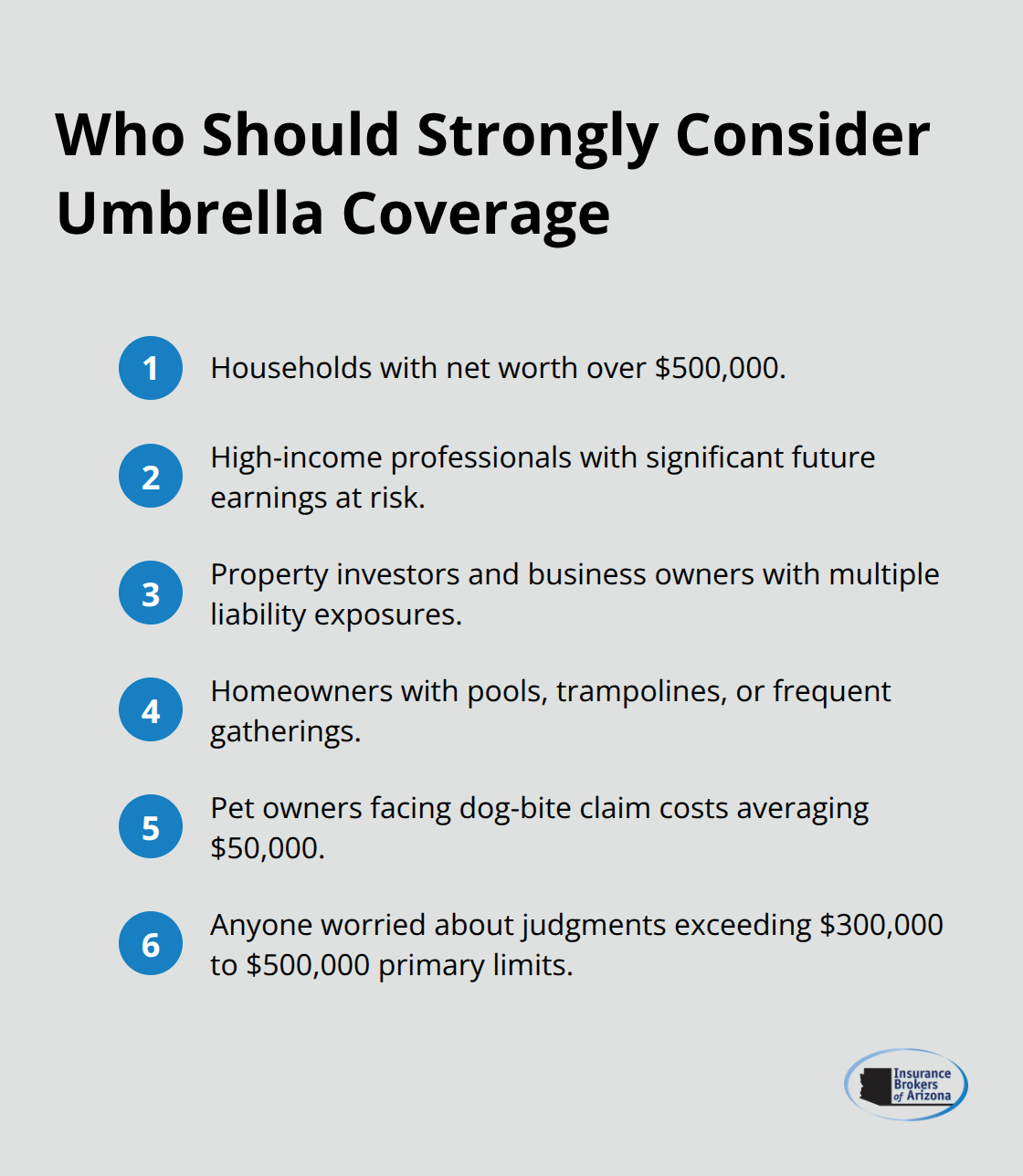
Your net worth determines whether umbrella insurance is optional or essential. If you own a home, have retirement accounts, or earn a solid income, you have assets worth protecting. The National Association of Insurance Commissioners reports that the average American household has a net worth of approximately $192,000, yet most carry homeowner’s liability limits of only $300,000 to $500,000. This gap creates real risk. Anyone with assets exceeding $500,000 should carry umbrella coverage, though the threshold can be lower depending on your liability exposure. A single lawsuit wipes out decades of savings, and once your primary insurance limits are exhausted, creditors pursue wage garnishment and asset seizure for years.
High-Income Professionals Face Elevated Risk
High-income professionals face elevated risk regardless of current assets because future earnings are also at stake. Physicians, attorneys, business owners, and executives face disproportionately higher lawsuit frequency according to insurance industry data. If your profession involves public interaction, decision-making authority, or managing other people’s money, your liability exposure increases significantly. Contractors, real estate agents, and property managers should treat umbrella coverage as non-negotiable rather than optional.
Property Investors and Business Owners Need Extra Protection
Property investors and business owners operate in a different risk category altogether. Each rental property you own multiplies your liability exposure exponentially. A tenant injured on your property, a guest hurt at a commercial location, or an employee claiming negligence generates claims far exceeding standard liability limits. Investors with multiple properties should carry umbrella coverage proportional to their portfolio value.
If you own a business with employees, your exposure includes not just bodily injury claims but also employment-related lawsuits, which have grown 400 percent over the past two decades according to the Equal Employment Opportunity Commission. The cost of defending against even a frivolous employment claim averages $160,000, which your business liability insurance may not fully cover.
Homeowners with High-Risk Activities Need Coverage
Homeowners with swimming pools, trampoline equipment, or frequent gatherings face higher slip-and-fall and injury claims. Pet owners should understand that dog bite liability claims average $50,000 and can exceed $100,000 when permanent scarring or disfigurement occurs. Your homeowner’s policy typically caps pet liability at $300,000, leaving significant exposure if you own multiple pets or larger breeds.
Calculating Your Actual Exposure
The decision to carry umbrella coverage hinges on whether you have anything to lose in a lawsuit, and most people do. Your liability exposure extends beyond what you currently own-it includes your future earning potential and any assets you plan to accumulate. Once you understand who needs umbrella coverage, the next step involves determining exactly how much protection your specific situation requires.
How Much Coverage Your Assets Actually Require
Calculate Your Total Liability Exposure
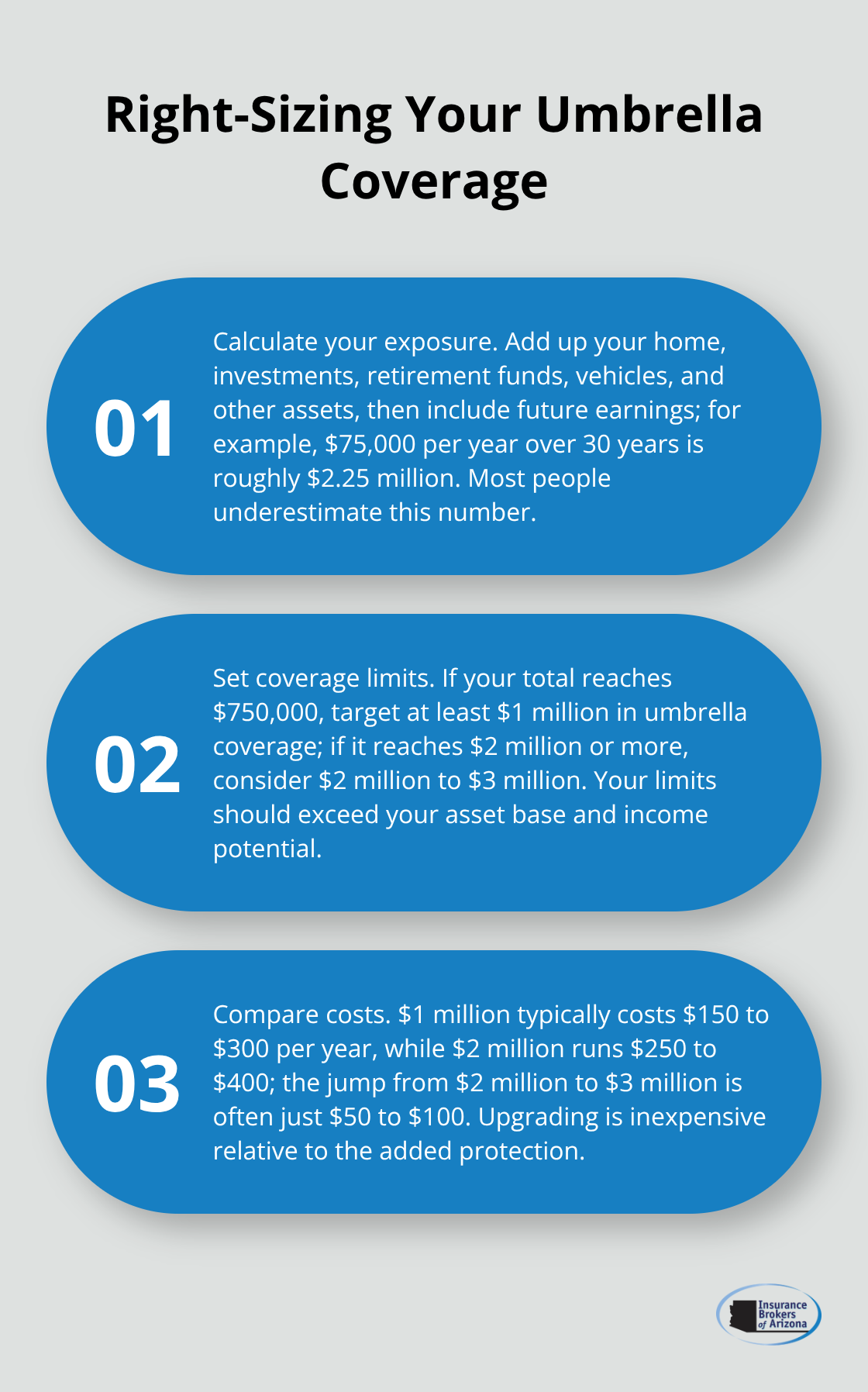
Start with a simple calculation: add up everything you own that could be seized in a lawsuit. Include your home value, investment accounts, retirement funds, vehicles, and any other significant assets. If you earn $75,000 annually, your future earning potential over the next 30 years represents roughly $2.25 million in additional liability exposure, assuming modest raises. Most people underestimate this number significantly. The Insurance Information Institute reports that the average liability judgment in personal injury cases exceeds $500,000, yet the median American household carries only $300,000 in homeowner’s liability coverage. This gap between actual exposure and actual coverage explains why umbrella policies exist.
Determine Your Coverage Limits
Calculate conservatively by adding your current net worth plus ten years of after-tax income. If that total reaches $750,000, you need at least $1 million in umbrella coverage. If it reaches $2 million or more, you should carry $2 million to $3 million in coverage. The math is straightforward: your coverage limits should exceed your total assets and income-generating capacity by a meaningful margin.
High-income professionals should never settle for $1 million coverage if their assets and earning potential exceed $1.5 million. Business owners with employees face employment-related litigation costs averaging $160,000 in defense alone, making $3 million umbrella coverage a practical necessity rather than an excess precaution.
Adjust Coverage Based on Your Lifestyle
Your lifestyle and daily activities determine whether you need coverage at the lower or upper end of that range. Homeowners with pools, hot tubs, or trampolines face claims 3 to 4 times more frequently than those without such features according to insurance loss data. If you host frequent gatherings, own pets, or operate any kind of rental property, move toward the higher coverage amounts.
Understand the Cost Difference
A $1 million umbrella policy costs $150 to $300 annually in most cases, while $2 million coverage runs $250 to $400 yearly. The difference between these tiers rarely exceeds $100 to $150 per year, making the upgrade financially insignificant relative to the additional protection. The cost differential between $2 million and $3 million coverage typically amounts to $50 to $100 annually.
Review Your Coverage Regularly
Your net worth increases over time, particularly after major life events like home purchases, business launches, or significant inheritance. Annual coverage reviews help you maintain adequate protection as your circumstances change.
Final Thoughts
Personal umbrella coverage protects your financial future when a single liability claim threatens everything you’ve built. Add your net worth to ten years of after-tax earnings, then carry umbrella coverage that exceeds that total by a meaningful margin. Most people need between $1 million and $3 million in coverage, depending on their circumstances.
High-income professionals, property investors, and business owners should lean toward the higher end of that range, while homeowners with pools, frequent gatherings, or rental properties face elevated claim frequency and should adjust their coverage accordingly. The cost difference between coverage tiers rarely exceeds $100 to $150 annually, making the upgrade financially insignificant relative to the protection gained. Your coverage needs change over time, and major life events like home purchases, business launches, or significant inheritance require coverage reviews to maintain adequate protection.
We at Insurance Brokers of Arizona® work with clients across Arizona to determine the right personal umbrella coverage for their specific situations. Contact us for a quote and let our team help you protect what matters most.
Disclaimer: The information provided in this blog is for general informational purposes only and does not constitute legal, financial, or insurance advice. Coverage options, terms, and availability may vary. Please consult with a licensed professional for advice specific to your situation.


