
Multi Car Coverage AZ: Building a Flexible Auto Insurance Plan

Arizona families with multiple vehicles face a real challenge: managing separate policies, missing out on discounts, and potentially leaving coverage gaps. Multi car coverage AZ doesn’t have to be complicated.
At Insurance Brokers of Arizona®, we help families build flexible auto insurance plans that protect every vehicle while cutting costs. The right strategy makes all the difference.
Why Multi-Car Coverage Makes Sense
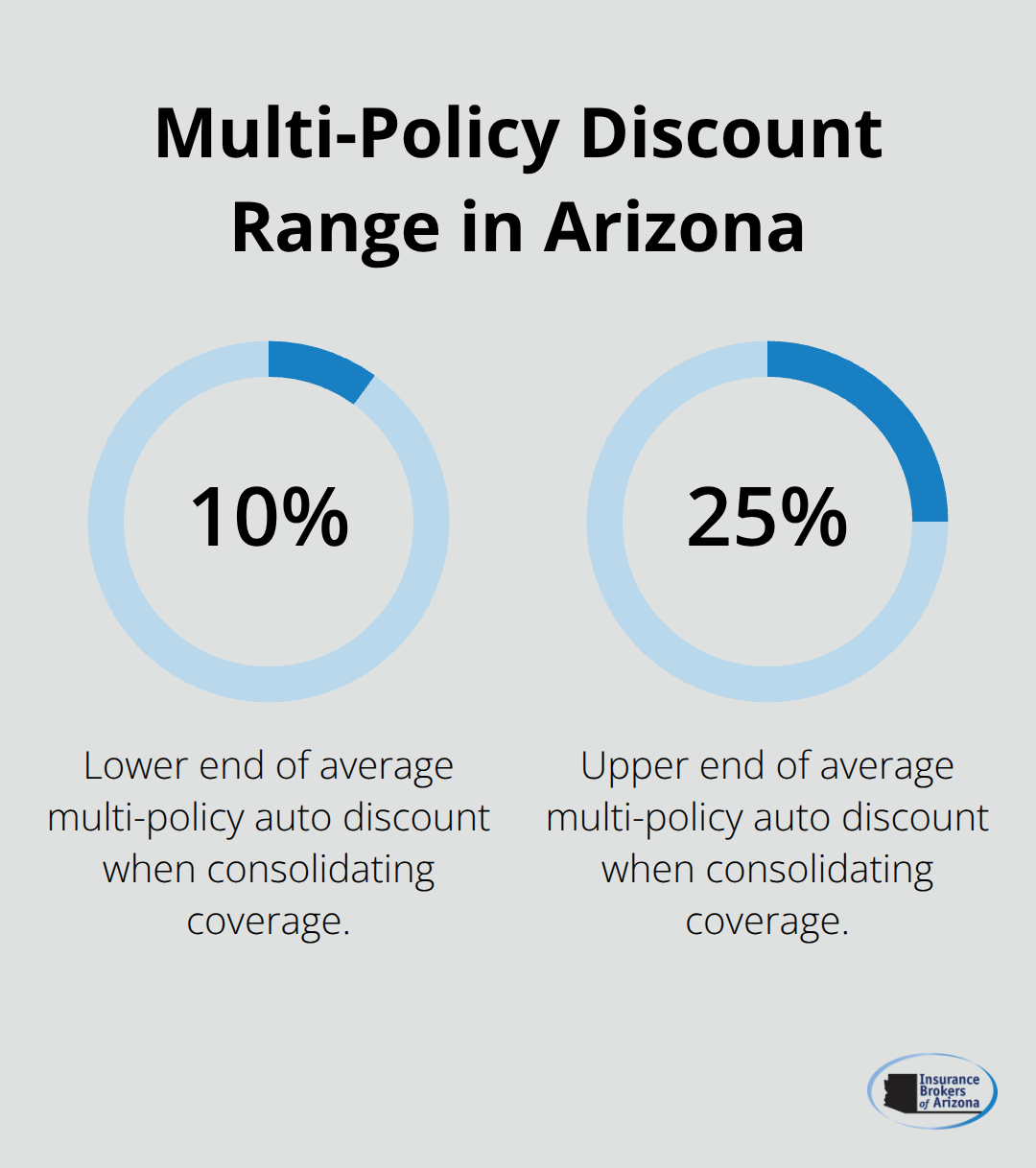
Arizona drivers with multiple vehicles typically pay significantly more than necessary. According to the National Association of Insurance Commissioners, households insuring two or more cars through separate policies miss out on multi-policy discounts that average between 10% and 25% annually. Families consolidating their auto policies under one provider save thousands of dollars. The savings compound quickly-a household with three vehicles could save $600 to $1,500 per year depending on coverage levels and driving records.
Managing multiple policies creates unnecessary friction. You juggle renewal dates, track different deductibles, handle claims through separate channels, and monitor coverage gaps that emerge when policies aren’t coordinated.
Coordination Prevents Coverage Gaps
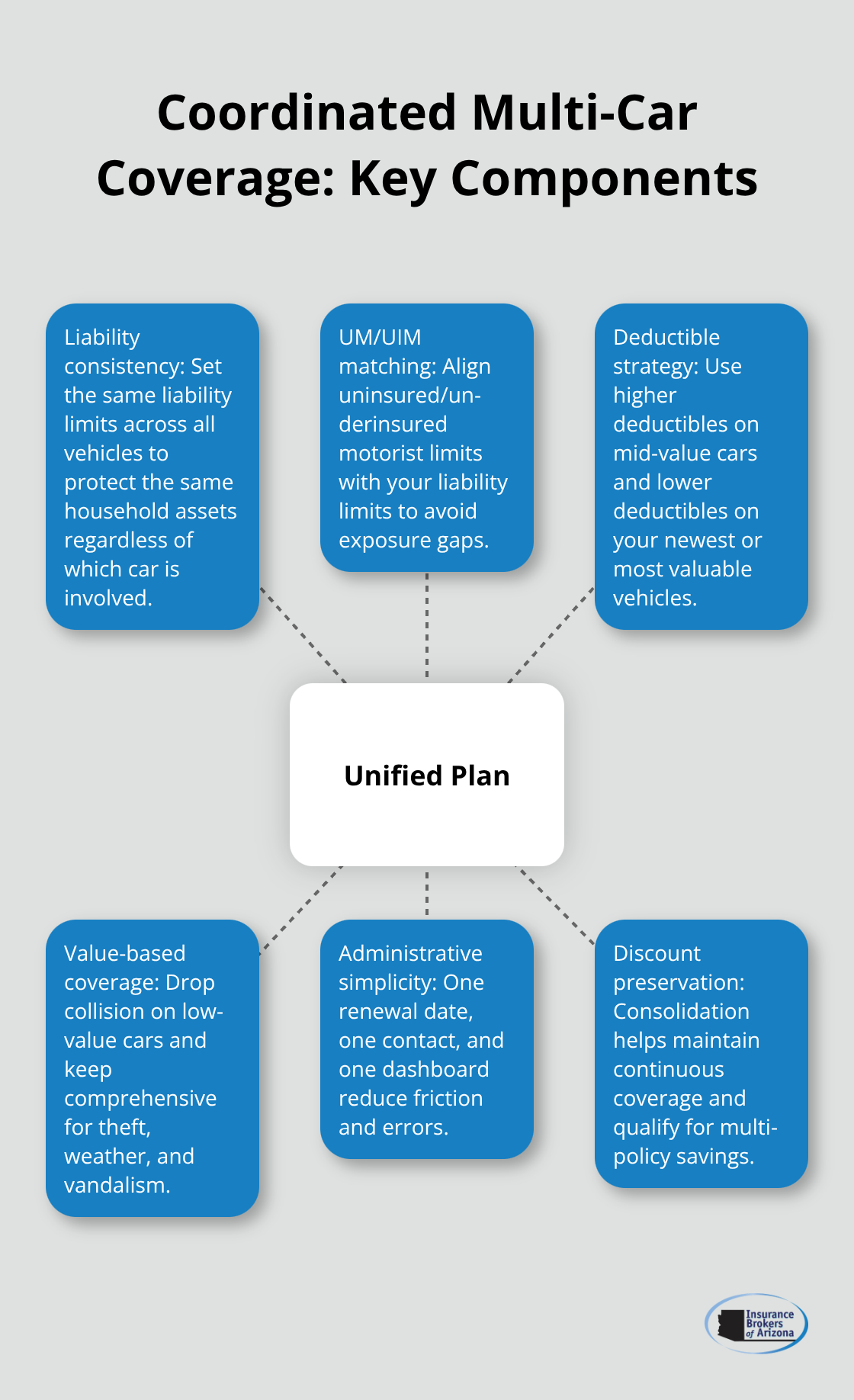
When vehicles are insured separately, critical protection falls through the cracks. Uninsured motorist coverage limits, liability caps, and collision deductibles vary dramatically between policies, leaving some cars underprotected while others carry redundant coverage. A coordinated multi-car plan protects your entire fleet consistently while eliminating duplicate coverages you don’t need. If you own a 2008 sedan worth $3,000 and a 2023 SUV worth $35,000, they require completely different approaches to collision and comprehensive coverage-but they should share the same liability and uninsured motorist limits for legal consistency. This coordination matters when vehicles serve different purposes. A car driven occasionally on weekends versus one used for commuting should have different coverage structures, but they should work together as a unified strategy rather than standalone policies. Arizona’s minimum liability requirements of 15/30/10 apply to every vehicle, but optimal coverage depends on your total household assets and risk exposure-something easier to evaluate holistically than vehicle by vehicle.
Simplified Administration and Claims
Managing one policy with multiple vehicles eliminates administrative headaches. You have one renewal date instead of three or four, one point of contact for questions, and one dashboard to review all your coverage. When a claim occurs, you work with a single claims team familiar with your complete situation rather than explaining your household setup repeatedly to different adjusters. This coordination becomes invaluable during complex situations. If you’re involved in an accident with one vehicle while another is being repaired, a consolidated broker relationship responds appropriately across both situations.
The Real Cost of Fragmented Coverage
Separate policies create hidden expenses beyond premium costs. Each policy carries its own deductible structure, meaning you could face multiple out-of-pocket costs in a single incident. Coordination eliminates this problem by establishing consistent deductibles across your fleet. Additionally, when you switch carriers or let policies lapse between renewals, you risk losing continuous coverage discounts that reward loyal customers. A unified approach maintains your discount eligibility and protects your driving record across all vehicles simultaneously.
Understanding these benefits sets the stage for building the right coverage structure. The next section walks through the specific coverage types that work together to create a comprehensive multi-car insurance plan.
Building Your Multi-Car Insurance Plan with the Right Coverage Types
Liability Coverage Forms Your Legal Foundation
Liability coverage forms the legal foundation of every auto policy in Arizona, and it’s where multi-car planning gets serious. Arizona requires minimum liability limits of 15/30/10, meaning $15,000 per person and $30,000 per accident for bodily injury, plus $10,000 for property damage. These minimums are dangerously low for households with assets to protect. If you cause an accident that injures multiple people or damages expensive property, liability claims regularly exceed $100,000. We recommend setting liability limits consistently across all vehicles at 100/300/100 or higher, especially if you have household assets worth more than $300,000. The cost difference between minimum coverage and adequate coverage is surprisingly small-typically $10 to $20 monthly per vehicle-but the protection difference is massive. When you coordinate liability across multiple cars, you protect the same personal assets regardless of which vehicle caused the damage.
Collision and Comprehensive Coverage Depends on Vehicle Value
Collision and comprehensive coverage decisions should depend entirely on each vehicle’s actual cash value, not on emotional attachment or outdated thinking. A 2008 sedan worth $3,000 shouldn’t carry a $500 deductible collision policy because you’d pay nearly 17% of the car’s value upfront before insurance kicks in. For vehicles worth less than $10,000, we recommend dropping collision coverage entirely and carrying only comprehensive, which covers theft, weather, and vandalism at a fraction of the cost. Vehicles worth $15,000 to $30,000 typically justify a $1,000 deductible collision policy, balancing reasonable premiums against meaningful protection. Your newest or most valuable vehicles warrant lower deductibles-$250 or $500-because the protection justifies the premium. This tiered approach across your fleet cuts unnecessary costs while protecting what matters.
Uninsured Motorist Coverage Requires Consistency
Uninsured and underinsured motorist coverage deserves the same consistency as liability. Arizona has roughly 1 in 8 drivers without insurance, according to the Insurance Institute for Highway Safety, meaning collision with an uninsured driver is a genuine risk. Set your uninsured motorist limits equal to your liability limits across all vehicles-if you carry 100/300 liability, carry 100/300 uninsured motorist. This consistency prevents gaps where one vehicle leaves you exposed. When you coordinate these limits across your entire fleet, you establish a unified protection strategy that responds to real Arizona driving conditions rather than treating each vehicle in isolation.
Common Mistakes Arizona Drivers Make When Insuring Multiple Vehicles
Collision Coverage on Older Vehicles Wastes Money Fast
Arizona drivers consistently mishandle older vehicles by applying the wrong coverage strategy. Many assume that a 2010 or 2012 car worth $5,000 to $8,000 needs the same collision coverage as a newer vehicle, leading them to pay $40 to $60 monthly for protection on an asset that depreciates faster than the premiums accumulate. The math fails quickly: if you pay $50 per month for collision coverage on a $6,000 vehicle with a $1,000 deductible, you need to avoid claims for over a decade just to break even financially.
For vehicles in this range, dropping collision entirely and keeping comprehensive coverage costs roughly one-third as much while protecting against theft, weather, and vandalism. This single adjustment saves families $300 to $600 annually without sacrificing meaningful protection. Your older vehicles still have comprehensive coverage when they need it most-during weather events or theft-while collision coverage sits unused.
Multi-Policy Discounts Disappear When You Don’t Ask
Drivers frequently ignore multi-policy discounts entirely or assume their current carrier offers the best multi-car rates without shopping competitors. The average multi-policy discount ranges from 10% to 25%, but many Arizona families never claim it because they never consolidated their coverage. A household paying $1,200 annually across two separate policies could save $120 to $300 per year through proper bundling, yet they continue with fragmented coverage out of inertia.
This mistake compounds over time. A family that fails to consolidate their policies for five years leaves $600 to $1,500 on the table. The solution requires one conversation with an insurance broker who can compare rates across multiple carriers and identify the savings your household qualifies for. Insurance Brokers of Arizona® partners with over 40 reputable carriers, making it possible to find competitive multi-car rates that match your specific situation.
Annual Reviews Catch Coverage Gaps Before They Become Problems
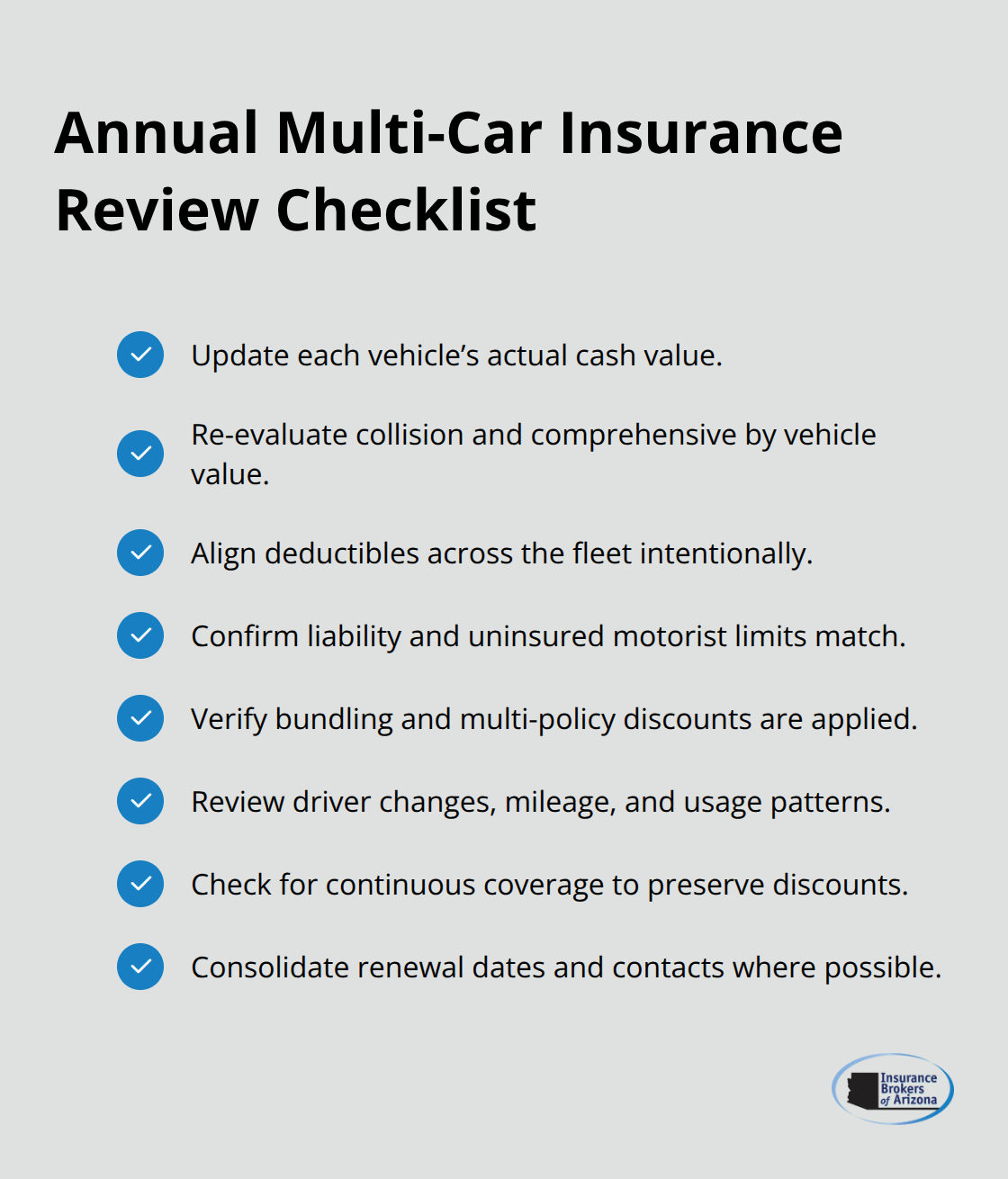
Arizona drivers treat insurance as a set-it-and-forget-it expense, ignoring coverage for three to five years until a major life event forces a review. A vehicle worth $25,000 when purchased might be worth $12,000 five years later, yet drivers maintain the same deductible structure and coverage limits throughout. This outdated approach leaves you either overpaying for unnecessary protection or underprotected on vehicles that still matter.
Arizona’s population growth and increased traffic density mean your risk profile in 2026 differs substantially from 2021. Drivers who review their multi-car plans annually catch these gaps and adjust before problems emerge, preventing both unnecessary premium waste and coverage shortfalls. Each year, reassess your vehicle values, driving patterns, and household assets to confirm your coverage still matches your actual situation.
Final Thoughts
Multi car coverage AZ works best when you stop treating each vehicle as an isolated insurance problem and start viewing your entire fleet as a coordinated strategy. The benefits are concrete: you save 10% to 25% on premiums through multi-policy discounts, eliminate administrative friction by managing one renewal date instead of multiple, and prevent coverage gaps that leave your household exposed. You align your protection with actual vehicle values and real Arizona driving conditions rather than applying generic coverage to every car.
Building this coordinated approach requires expertise that goes beyond shopping rates online. Brokers understand how different coverage types interact across multiple vehicles, identify which discounts apply to your specific situation, and adjust your plan as your vehicles and circumstances change. We at Insurance Brokers of Arizona® work with numerous reputable carriers, meaning we can compare options across the market rather than pushing you toward a single company’s offerings.
Contact Insurance Brokers of Arizona® to discuss your situation with someone who understands Arizona’s specific insurance landscape. A broker review typically takes 20 to 30 minutes and often uncovers savings or coverage improvements you wouldn’t find on your own. Your household’s protection and budget deserve that level of attention.
Disclaimer: The information provided in this blog is for general informational purposes only and does not constitute legal, financial, or insurance advice. Coverage options, terms, and availability may vary. Please consult with a licensed professional for advice specific to your situation.


